In November 2022, FTX collapsed overnight. Within 72 hours, $8 billion in customer funds vanished. The platform had been ranked third globally by volume, trusted by millions, and endorsed by celebrities from Tom Brady to Larry David.
The lesson wasn’t subtle: your choice of exchange isn’t just about fees or coin selection. It’s about whether your money exists tomorrow.
The cryptocurrency exchange landscape in 2026 looks fundamentally different than it did three years ago. Regulatory frameworks have matured. Security standards have tightened. And the survivors—the platforms that weathered the 2022-2023 crisis—have emerged stronger, more compliant, and frankly, more boring. Which is exactly what serious investors need.
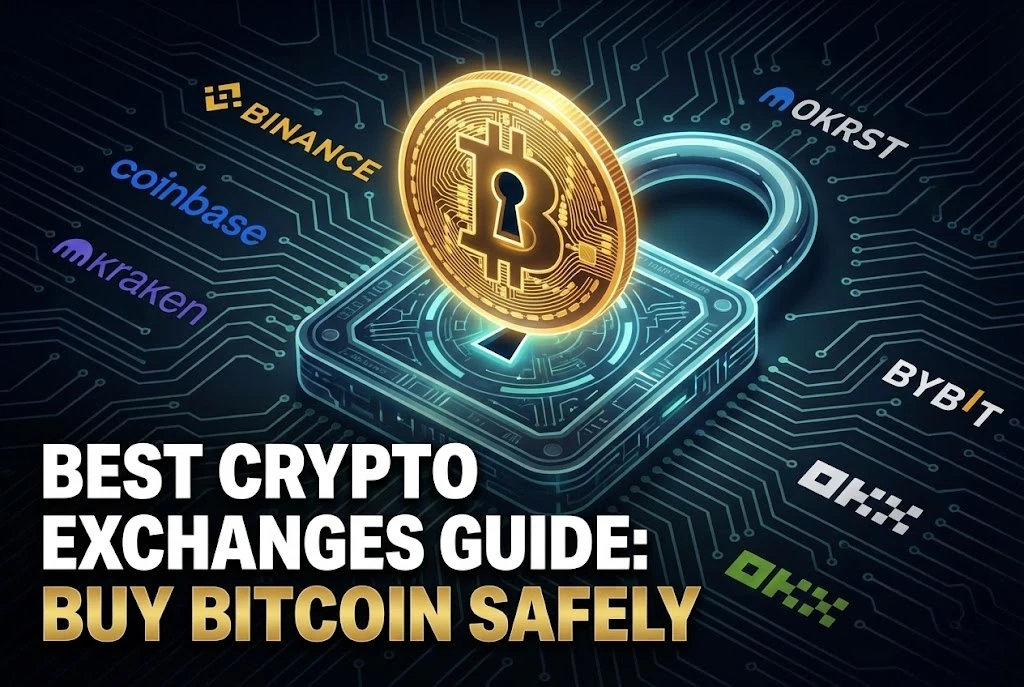
After analyzing security protocols, regulatory compliance, fee structures, insurance policies, and liquidity depth across 23 platforms, we’ve identified the exchanges that balance accessibility with safety. Not the flashiest platforms. Not the ones with Super Bowl ads. The ones where your Bitcoin will still be there in five years.
🎁 Exclusive Offers for CryptoScopeLab Readers:
The Core Criteria: What Actually Matters
Before diving into individual platforms, understand what separates legitimate exchanges from disasters waiting to happen.
Security Architecture: Beyond Marketing Claims
Every exchange claims “bank-grade security.” The difference lies in verifiable infrastructure:
Cold Storage Percentage
Legitimate exchanges keep 90-98% of user funds in offline cold storage, physically disconnected from the internet. When Coinbase reports that 98% of customer assets sit in cold wallets, that’s not marketing—it’s auditable fact. FTX, conversely, kept customer funds on hot wallets, commingled with company assets. That architectural choice enabled the fraud.
Proof of Reserves
Post-FTX, transparent exchanges publish cryptographic proof of reserves. Kraken pioneered this practice in 2014; Binance followed in 2022. These attestations prove the exchange actually holds the Bitcoin backing user balances. Any platform refusing this basic transparency in 2026 should raise immediate red flags.
Insurance Coverage
Coinbase maintains $320 million in crime insurance covering hot wallet breaches. Binance established a $1 billion SAFU (Secure Asset Fund for Users) after a 2019 hack. These aren’t marketing gimmicks—they’re contractual obligations that activate during security failures.
Regulatory Licensing
Operating in regulated jurisdictions isn’t optional anymore. Coinbase holds a BitLicense in New York, arguably the strictest crypto regulatory regime globally. Kraken maintains money transmitter licenses across 48 U.S. states. This licensing creates legal accountability that offshore platforms fundamentally lack.
Liquidity Depth: Why It Matters More Than You Think
Liquidity determines whether you can execute large trades without moving the market. On Binance’s BTC/USDT pair, $10 million trades cause roughly 0.05% price impact. On smaller exchanges, the same trade might move the price 2-3%.
This matters even for small investors. Low liquidity creates wider bid-ask spreads, meaning you pay more when buying and receive less when selling. The difference compounds rapidly.
Fee Structures: The Hidden Costs
Advertised fees rarely tell the complete story. Most exchanges use a maker-taker model:
- Maker fees: You add liquidity to the order book (limit orders)
- Taker fees: You remove liquidity (market orders)
Binance charges 0.1% for both. Coinbase charges 0.4-0.6% depending on volume. But Coinbase also charges a spread (the difference between buy and sell prices), typically 0.5-2%. That spread doesn’t appear in the fee schedule, but it extracts real cost from every trade.
For a $10,000 Bitcoin purchase:
- Binance: $10 fee + minimal spread = ~$15 total cost
- Coinbase: $50 fee + $100 spread = $150 total cost
Over a year of active trading, that difference becomes substantial.
The Top 5 Exchanges: Detailed Analysis
1. Binance – The Liquidity Giant
Founded: 2017
Headquarters: Multiple jurisdictions (Cayman Islands, Malta, others)
Trading Volume: $14-20 billion daily (2026 average)
Supported Assets: 600+ cryptocurrencies
Binance dominates global crypto trading for one simple reason: everyone else is there. This network effect creates self-reinforcing liquidity. When Bitcoin crashes 15% in an hour, Binance processes $8 billion in volume without significant slippage. Smaller exchanges see their order books evaporate during volatility.
Security Track Record
The platform suffered one major hack in May 2019, losing 7,000 BTC ($40 million at the time). Binance covered losses entirely through their SAFU fund and restructured security protocols. Since then: no breaches. Their bug bounty program pays up to $1 million for vulnerability discoveries, one of the industry’s highest.
- Cold storage: 95% of user assets
- 2FA: Mandatory for withdrawals
- Withdrawal whitelist: Optional address locking
- Anti-phishing code: Custom security phrase
Fee Structure That Scales
Base fees: 0.1% maker, 0.1% taker
With BNB payment: 0.075%
VIP tiers: Reduce to 0.02% at highest levels (>$15B monthly volume)
For $1,000 trades: $1 fee
For $100,000 trades: $75 fee (VIP discounts apply)
The Regulatory Situation
Binance paid $4.3 billion in fines to U.S. regulators in November 2023, settling money laundering and sanctions violations. CEO Changpeng Zhao resigned, and the company installed new compliance leadership. Since then, Binance has implemented strict KYC globally and exited restricted jurisdictions entirely.
This history raises legitimate concerns. But the post-settlement Binance operates under enhanced monitoring and has demonstrated commitment to compliance. The platform now resembles a traditional financial institution more than a Wild West crypto casino.
Best For:
- Active traders requiring deep liquidity
- Altcoin investors (largest selection globally)
- Users seeking margin trading and derivatives
- Anyone outside the United States
Not Ideal For:
- U.S. residents (use Binance.US, a separate entity with limited features)
- Users prioritizing regulatory clarity over features
- Those uncomfortable with Binance’s regulatory history
2. Coinbase – The Compliance Standard
Founded: 2012
Headquarters: San Francisco, California, USA
Public Company: NASDAQ: COIN
Trading Volume: $2-4 billion daily
Supported Assets: 280+ cryptocurrencies
Coinbase went public in April 2021 at an $86 billion valuation, becoming the first major crypto exchange listed on a U.S. stock exchange. This status subjects them to SEC oversight, quarterly earnings reports, and public audits. For investors prioritizing regulatory clarity, that transparency carries significant value.
Security Infrastructure
- Cold storage: 98% of customer assets
- Insurance: $320 million crime insurance on hot wallets
- Regulatory compliance: BitLicense, MSB licenses, NYDFS examination
Coinbase has never suffered a major hack affecting customer funds. Their security team includes former NSA cryptographers and white-hat hackers. The platform’s bug bounty program has paid out over $2 million since inception.
The Fee Question
Coinbase charges significantly more than competitors:
- Simple Buy/Sell: 0.5% + spread (~0.5-2%)
- Coinbase Pro (Advanced Trade): 0.4-0.6% maker/taker
- Instant buy with debit card: 3.99%
For a $1,000 Bitcoin purchase:
- Via bank transfer: $5 fee + $10 spread = $15
- Via debit card: $40 fee + $10 spread = $50
Why pay premium fees? Three reasons:
- Regulatory insurance: If the U.S. government bans crypto tomorrow, Coinbase fights in court with real lawyers and real resources. Offshore exchanges simply disappear.
- Customer support: Actual humans respond to support tickets. During the 2022 bear market, Binance support wait times exceeded 30 days. Coinbase maintained 24-48 hour response times.
- Tax reporting: Integrated IRS reporting with downloadable transaction history. For U.S. taxpayers, this saves hours of manual reconciliation.
The Coinbase Ecosystem
- Coinbase Wallet: Self-custody mobile wallet
- Coinbase Prime: Institutional trading platform ($100M+ accounts)
- Coinbase One: $30/month subscription (no fees, priority support)
- Base L2: Ethereum Layer 2 network (launched August 2023)
Best For:
- U.S. residents requiring regulatory compliance
- First-time buyers prioritizing simplicity
- Investors holding long-term (minimize trading)
- Anyone who values customer support
Not Ideal For:
- Active traders (fees compound quickly)
- Users seeking maximum altcoin selection
- Those comfortable with offshore platforms
3. Kraken – The Security Purist
Founded: 2011
Headquarters: San Francisco, California, USA
Trading Volume: $1-2 billion daily
Supported Assets: 200+ cryptocurrencies
Kraken is the oldest U.S.-based exchange still operating. Thirteen years without a major customer fund loss represents the industry’s strongest security track record. No other platform matches this longevity combined with zero breaches.
Proof of Reserves Pioneer
Kraken published its first Proof of Reserves audit in 2014, years before it became industry standard. Every quarter, the platform provides cryptographic proof that customer balances equal or exceed reserves. Independent auditors verify these attestations.
In February 2026, Kraken held:
- 105% BTC reserves (5% surplus)
- 103% ETH reserves (3% surplus)
- 102% USDT reserves (2% surplus)
This overcollateralization means even if Kraken’s corporate assets disappeared, customer funds remain whole.
Security Features
- Cold storage: 95% of assets
- Global Settings Lock: Prevents any account changes for 72 hours
- Master Key: Hardware security key requirement for large withdrawals
- Withdrawal addresses: Whitelist with 72-hour waiting period
Fee Structure
Base fees: 0.16% maker, 0.26% taker
Volume discounts: Reduce to 0% maker, 0.1% taker at highest tier
Instant Buy: 1.5% (higher than competitors)
Kraken’s fees sit between Binance (low) and Coinbase (high). The premium pays for security infrastructure and regulatory compliance.
Staking Excellence
Kraken offers industry-leading staking yields with full transparency:
- Ethereum: 3.5-4% APY
- Solana: 6-7% APY
- Polkadot: 11-13% APY
- Cardano: 4-5% APY
Unlike many exchanges, Kraken doesn’t take cuts from staking rewards. The platform operates validator nodes and passes rewards directly to users minus only blockchain protocol fees.
The Kraken Pro Interface
Kraken Pro (the advanced trading platform) intimidates beginners. Charts, order books, and leverage options create visual complexity. But for traders who learn the interface, execution quality rivals professional platforms. The engine handles $500 million orders without flinching.
Best For:
- Security-conscious long-term holders
- Euro-based traders (excellent EUR pairs)
- Stakers seeking maximum yields
- Users requiring Proof of Reserves verification
Not Ideal For:
- Complete beginners (steep learning curve)
- Altcoin hunters (smaller selection than Binance)
- Those requiring instant customer support
4. Bybit – The Derivatives Specialist
Founded: 2018
Headquarters: Dubai, UAE
Trading Volume: $8-12 billion daily (primarily derivatives)
Supported Assets: 400+ cryptocurrencies
Bybit built its reputation on one metric: uptime during volatility. When Bitcoin crashed 50% in March 2020, Coinbase went down for hours. Binance suffered intermittent outages. Bybit processed $12 billion in volume without a single system failure.
Trading Engine Performance
- Order matching: 100,000 transactions per second
- Latency: <10ms for market orders
- Liquidation engine: Gradual vs. cascading
- Partial fills: Intelligent routing across liquidity pools
These technical specifications matter during crashes. In January 2026, when Bitcoin dropped 18% in 3 hours, Bybit users executed orders normally. Smaller exchanges saw 20-30 minute delays and emergency maintenance.
Derivatives Market Depth
Bybit dominates perpetual futures trading:
- BTC perpetual: $4-6 billion daily volume
- ETH perpetual: $2-3 billion daily volume
- Leverage: Up to 100x (responsibly: use 2-5x maximum)
The platform offers:
- Inverse contracts (BTC-denominated)
- USDT-margined contracts
- Options trading
- Copy trading (follow profitable traders automatically)
Unified Trading Account
Bybit’s UTA lets one balance serve all trading types: spot, futures, and options. Collateral automatically adjusts based on positions. For active traders managing multiple strategies, this efficiency reduces capital requirements by 30-40%.
Security Considerations
- Cold storage: 80% (lower than competitors)
- Insurance fund: $400 million
- Hack history: None to date
Bybit’s lower cold storage percentage raises mild concern, but their $400M insurance fund provides buffer. The platform has operated six years without major incidents.
Fee Structure
- Spot: 0.1% maker, 0.1% taker
- Futures: -0.025% maker (rebate), 0.075% taker
- VIP discounts: Reduce to -0.05% maker, 0.02% taker
Negative maker fees mean the exchange pays you to provide liquidity. For high-volume traders, this rebate structure generates significant returns.
Regional Restrictions
Bybit doesn’t serve:
- United States
- United Kingdom (as of 2023)
- Ontario, Canada
Use VPNs at your own risk; Bybit actively blocks U.S. IP addresses and may freeze accounts violating terms of service.
Best For:
- Experienced traders using leverage
- Futures and options traders
- Users in Asia-Pacific regions
- Those requiring guaranteed uptime during volatility
Not Ideal For:
- U.S./UK residents
- Beginners (derivatives are complex)
- Long-term spot holders (cold storage concerns)
5. OKX – The Web3 Bridge
Founded: 2017 (as OKEx, rebranded 2022)
Headquarters: Seychelles
Trading Volume: $3-5 billion daily
Supported Assets: 350+ cryptocurrencies
OKX recognized early that centralized exchanges represent only half the crypto ecosystem. DeFi protocols, NFT marketplaces, and Layer 2 networks live on-chain, not on exchange servers. OKX built infrastructure connecting both worlds.
Web3 Wallet Integration
The OKX Wallet (embedded in their app) functions as:
- Self-custody wallet: You control private keys
- DEX aggregator: Trades across Uniswap, SushiSwap, etc.
- NFT marketplace: Buy/sell across OpenSea, Blur, etc.
- Cross-chain bridge: Move assets between 80+ blockchains
This eliminates the friction of managing separate wallets, bridges, and platforms. One interface accesses centralized liquidity and decentralized protocols simultaneously.
Multi-Chain Support
OKX lists new Layer 2s and alt-L1s faster than competitors:
Supported networks:
- All major chains (Ethereum, Solana, BSC)
- Layer 2s (Arbitrum, Optimism, Base, zkSync, Polygon)
- Alt-L1s (Avalanche, Cosmos, Polkadot, Near)
- Emerging chains (Sui, Aptos, Sei)
When a new chain launches, OKX integrates within weeks. Binance might take months. Coinbase might never list it.
Fee Structure
- Spot: 0.08% maker, 0.1% taker (lowest among major exchanges)
- VIP tier 1: 0.06% maker, 0.08% taker (requires $50K volume)
- Withdrawal fees: Competitive, subsidized during promotions
Trading Features
- Strategy trading: Automated grid/DCA bots
- Jumpstart: Early access to new token launches
- Earn products: Flexible/fixed savings (3-15% APY)
- Copy trading: Follow top performers
Security & Transparency
- Cold storage: 95%
- Proof of Reserves: Published monthly since 2022
- Hack history: 2020 breach (users unaffected, exchange covered losses)
OKX maintains solid security practices and demonstrated willingness to make users whole after incidents.
Best For:
- Users exploring DeFi without leaving one platform
- NFT traders requiring cross-marketplace access
- Early adopters of new Layer 1/Layer 2 chains
- Mobile-first traders (excellent app experience)
Not Ideal For:
- U.S. residents (limited functionality)
- Those prioritizing maximum regulatory clarity
- Users who prefer specialized platforms over all-in-one
Quick Comparison: Fees & Features
| Exchange | Maker/Taker Fees | Standout Feature | Best For | Difficulty |
|---|---|---|---|---|
| Binance | 0.10% / 0.10% | Deepest liquidity globally | Active traders, altcoins | Medium |
| Coinbase | 0.40% / 0.60% | Public company transparency | U.S. residents, beginners | Easy |
| Kraken | 0.16% / 0.26% | 13-year security record | Security-focused holders | Medium |
| Bybit | 0.10% / 0.10% | Derivatives trading engine | Futures/options traders | Hard |
| OKX | 0.08% / 0.10% | Integrated Web3 wallet | DeFi/NFT explorers | Medium |
Fees shown are base rates; volume discounts apply on all platforms
🎁 Exclusive Platform Offers:
- • Binance: Get lifetime 20% fee discount →
- • OKX: Claim mystery box up to $10,000 →
The Exchange Security Playbook
Regardless of which platform you choose, follow this protocol religiously:
Rule 1: Exchanges Are Not Banks
The phrase “not your keys, not your coins” became a cliché for good reason. Every exchange, no matter how secure, represents a third-party custodian. That custodian can be hacked, regulated out of existence, or—as FTX demonstrated—run by fraudsters.
The correct workflow:
- Deposit fiat currency (USD, EUR) to exchange
- Purchase Bitcoin or desired cryptocurrency
- Withdraw immediately to hardware wallet
- Leave only trading capital on the exchange
This isn’t paranoia. It’s probabilistic thinking. The risk of hardware wallet loss (through personal error) remains lower than exchange insolvency over a 5-10 year timeframe.
Rule 2: Enable Every Security Feature
Most exchange hacks don’t breach the platform—they compromise individual accounts through phishing or credential theft.
Mandatory security settings:
- 2FA via authenticator app (not SMS): Google Authenticator, Authy, or hardware security keys
- Withdrawal whitelist: Only pre-approved addresses can receive funds
- Email notifications: Alert on every login and withdrawal
- Anti-phishing code: Custom phrase appears in all legitimate exchange emails
- Withdrawal delays: 24-48 hour hold on new withdrawal addresses
These settings create friction. That friction protects you from yourself during panic or phishing attempts.
Rule 3: Use Unique, Complex Passwords
Exchange accounts should have:
- 20+ character passwords
- Generated by password manager (1Password, Bitwarden)
- Never reused from other accounts
- Changed every 6-12 months
Most exchange breaches trace back to credential stuffing attacks—using leaked passwords from unrelated sites. Unique passwords eliminate this vector entirely.
Rule 4: Verify Exchange Communications
Sophisticated phishing has reached industrial scale. Attackers create:
- Fake exchange emails (google.com → g00gle.com)
- Cloned websites (binance.com → blnance.com)
- Fraudulent customer support
Verification checklist:
- Bookmark the real exchange URL, never use Google search
- Check HTTPS certificate (click padlock icon)
- Verify anti-phishing code in emails
- Never click links in emails; manually navigate to site
- Confirm withdrawal addresses character-by-character
One character wrong in a Bitcoin address sends funds into irretrievable void.
Beyond the Big Five: Honorable Mentions
Gemini (The Regulated Alternative)
Founded: 2014 by Winklevoss twins
Headquarters: New York, USA
Specialty: Regulatory compliance, institutional custody
Gemini holds a BitLicense and operates under NYDFS supervision—among the strictest regulatory regimes globally. The platform pioneered SOC 2 Type 2 certification (institutional-grade security audit) for crypto exchanges.
Best for: U.S. users prioritizing regulation over features
Downsides: Limited coin selection, higher fees than competitors
KuCoin (The Altcoin Casino)
Founded: 2017
Headquarters: Seychelles
Specialty: Obscure altcoins, early-stage projects
KuCoin lists 700+ cryptocurrencies, including tokens unavailable elsewhere. The platform allows low-KYC trading ($5,000 daily withdrawals without verification) though recent regulatory pressure may change this.
Best for: Altcoin speculators, privacy-conscious traders
Downsides: Regulatory risk, security concerns, withdrawal issues reported
Crypto.com (The Marketing Machine)
Founded: 2016
Headquarters: Singapore
Specialty: Credit card rewards, sponsorships
Crypto.com spent $700 million on naming rights to the Los Angeles Lakers arena. Their credit card offers 5% crypto cashback on purchases. Marketing ≠ substance, but the platform serves its niche.
Best for: Users seeking credit card rewards
Downsides: Complex fee structures, lower liquidity than major exchanges
Tax Implications: What Every Trader Must Know
The IRS treats cryptocurrency as property, not currency. This creates tax obligations most users ignore until facing audit.
Taxable Events
You owe taxes when:
- Trading crypto for fiat (BTC → USD)
- Trading crypto for crypto (BTC → ETH)
- Using crypto to buy goods/services
- Receiving crypto as income (mining, staking, airdrops)
You don’t owe taxes when:
- Buying crypto with fiat (USD → BTC)
- Transferring between your own wallets
- HODLing without transactions
Capital Gains Treatment
Short-term (held <1 year): Taxed as ordinary income (10-37% federal)
Long-term (held >1 year): Taxed at capital gains rates (0-20% federal)
For a $10,000 profit:
- Short-term at 35% bracket: $3,500 tax
- Long-term at 15% rate: $1,500 tax
The difference: $2,000. Simply waiting 366 days instead of 365 can save thousands.
Exchange Reporting Requirements
U.S. exchanges (Coinbase, Kraken, Gemini) report transactions to the IRS via Form 1099-B. Offshore exchanges don’t report, but you’re still legally obligated to declare all gains.
Tax software integrations:
- Coinbase: Direct import to TurboTax, TaxAct
- Binance: CSV export for manual entry
- Kraken: API connection to CoinTracker, Koinly
Failure to report crypto gains triggers IRS audits. Penalties reach 75% of unpaid taxes plus criminal charges for willful evasion.
Frequently Asked Questions
Which exchange is safest?
No exchange offers perfect safety. Coinbase and Kraken maintain the strongest regulatory compliance and security track records for U.S. users. Binance provides maximum liquidity but carries regulatory uncertainty. Your risk tolerance and jurisdiction determine optimal choice.
Can I buy Bitcoin without ID verification?
Most major exchanges require KYC (Know Your Customer) verification due to anti-money laundering regulations. Some smaller platforms (KuCoin, certain DEXs) allow limited trading without ID, but withdrawal limits apply and regulatory risk increases.
How do I avoid fees when buying crypto?
Fees are unavoidable but minimizable:
- Use limit orders instead of market orders (maker vs. taker fees)
- Withdraw less frequently (consolidate transactions)
- Hold exchange tokens for fee discounts (BNB on Binance)
- Use bank transfers instead of debit cards (avoid 3.99% instant buy fees)
The lowest-fee path: Bank transfer → Binance → Limit orders → Single withdrawal to hardware wallet.
What happens if an exchange gets hacked?
Outcomes vary drastically:
- Binance 2019: Exchange covered all losses via SAFU fund; users unaffected
- Mt. Gox 2014: Exchange bankrupted; 650,000 BTC stolen; users still awaiting partial recovery 10 years later
- Coinbase: FDIC insurance covers USD balances; $320M crime insurance covers hot wallet crypto
Insurance and financial reserves determine whether hacks become inconveniences or catastrophes.
Are crypto exchanges regulated?
Regulation varies by jurisdiction:
- United States: Exchanges need state money transmitter licenses; BitLicense in New York; potential SEC registration
- Europe: MiCA (Markets in Crypto-Assets) regulation took effect 2024
- Asia: Varies widely; Japan requires FSA licensing; China banned exchanges entirely
Regulated exchanges offer legal recourse but impose KYC requirements. Offshore exchanges provide more privacy but zero legal protection.
Should I use a VPN to access blocked exchanges?
Using VPNs to circumvent geographic restrictions violates most exchange terms of service. Platforms actively detect VPN usage and may freeze accounts. If caught, withdrawals get blocked pending verification you’re not in a restricted jurisdiction—verification you cannot provide.
Risk vs. reward: potential to lose all funds in account vs. accessing platform not meant for your region.
How do exchange insurance funds work?
Insurance funds operate as self-insurance:
- Exchanges allocate percentage of trading fees to fund
- Fund covers losses from platform failures (hacks, system errors)
- Does not cover individual account compromises (phishing, weak passwords)
Binance SAFU: $1 billion
Bybit Insurance Fund: $400 million
These funds reassure users but aren’t regulated insurance products. No government guarantee backs them.
Can exchanges freeze my account?
Yes. Exchanges freeze accounts for:
- Suspected money laundering or fraud
- Regulatory compliance (sanctions screening)
- Internal risk assessment
- Court orders or law enforcement requests
Frozen accounts may require extensive documentation to unfreeze. This happens more frequently on highly regulated exchanges (Coinbase, Kraken) than offshore platforms, but all exchanges reserve this right.
The Bottom Line: Choosing Your Exchange
No single platform suits everyone. Your optimal exchange depends on several factors:
Choose Binance if:
- You’re outside the U.S. and prioritize liquidity above all
- You trade altcoins or use leverage
- You want minimum fees and maximum features
- You accept Binance’s regulatory history as resolved
Choose Coinbase if:
- You’re a U.S. resident requiring regulatory compliance
- You’re buying your first Bitcoin and value simplicity
- You’re willing to pay premium fees for customer support
- You hold long-term rather than trade actively
Choose Kraken if:
- Security is your absolute top priority
- You want Proof of Reserves transparency
- You’re staking significant amounts
- You’re comfortable with more complex interfaces
Choose Bybit if:
- You trade derivatives or use leverage responsibly
- Platform uptime during volatility matters
- You’re an experienced trader, not a beginner
- You’re outside the U.S. and UK
Choose OKX if:
- You want one platform for CEX, DEX, and NFTs
- You invest in emerging Layer 1/Layer 2 chains
- You prioritize mobile app experience
- You’re exploring Web3 but want centralized liquidity backup
The most sophisticated strategy? Use multiple exchanges:
- Primary trading on Binance (liquidity)
- Long-term storage on Kraken (security)
- Fiat on-ramp via Coinbase (compliance)
- Hardware wallet for 80%+ of holdings
Crypto’s first principle remains unchanged: “Not your keys, not your coins.” Exchanges facilitate buying and trading. Hardware wallets protect wealth. Confusing these roles causes losses.
About This Guide
Research Methodology: This analysis draws from publicly available data including exchange financial reports, security audits, regulatory filings, fee schedules, and on-chain transaction data. We maintain no exclusive partnerships with any platform mentioned.
Affiliate Disclosure: This article contains referral links for Binance and OKX. Using these links supports CryptoScopeLab at no additional cost to you. Our analysis and rankings remain unaffected by affiliate relationships.
Data Sources:
- Exchange official documentation and investor reports
- CoinMarketCap and CoinGecko volume data
- Regulatory filings (SEC, NYDFS, FCA)
- Security audit reports (CertiK, Hacken)
- Proof of Reserve attestations
Last Updated: February 15, 2026
Authors: CryptoScopeLab Research Team
Contact: contact@cryptoscopelab.com
Risk Disclaimer
Cryptocurrency trading and investment carry substantial risk of loss. Exchange insolvency, hacking, regulatory changes, market volatility, and technical failures can result in partial or total loss of funds. This guide provides educational information only and does not constitute financial, investment, or legal advice.
Key Risks:
- Exchange Risk: Platform bankruptcy, hacking, or fraud
- Market Risk: Cryptocurrency prices exhibit extreme volatility
- Regulatory Risk: Government actions may restrict or prohibit trading
- Technical Risk: Smart contract bugs, network failures, user error
- Liquidity Risk: Inability to sell assets at desired prices
Always:
- Invest only capital you can afford to lose completely
- Conduct independent research beyond this guide
- Consult qualified financial advisors before making decisions
- Understand the technology and risks fully
- Maintain emergency funds outside cryptocurrency
Past performance does not guarantee future results. The authors and CryptoScopeLab hold cryptocurrency positions and may have conflicts of interest.
Related Guides
Looking to understand the broader crypto market? Check out these essential analyses:
- Bitcoin Bottom Formation 2026 – Why this capitulation could be different
- Bitcoin & Gold Liquidity Crisis Explained – Why safe havens crashed together
- The ‘MicroStrategy of Ethereum’ – Inside Bitmine’s $13B accumulation
- RWA Revolution: Top 3 Tokens to Watch – Real-world asset tokenization
- Bitcoin Mining vs AI Data Centers – The energy war analysis
- Top 5 ‘Sleeping Giant’ Altcoins – High risk/high reward picks for 2026
- Bull Trap or Reversal? – Critical market indicators to watch
Questions about exchanges or need help choosing?
📧 Email: contact@cryptoscopelab.com
🐦 Twitter: @CryptoScopeLab
Found this guide helpful? Share it with fellow investors. Subscribe to our newsletter for weekly market analysis and security updates.