The RWA Revolution: How Real-World Assets Are Reshaping Crypto in 2026
In March 2024, BlackRock—the world’s largest asset manager with $10 trillion under management—filed to launch BUIDL, its first tokenized money market fund. By February 2026, that fund held over $500 million in assets. JPMorgan followed with MONY, launching directly on Ethereum mainnet. Siemens issued $300 million in tokenized bonds.
Published
December 3, 2025
Last Updated
February 15, 2026
This isn’t experimental anymore. The financial infrastructure that moves trillions daily is migrating to blockchains.
Larry Fink, BlackRock’s CEO, called tokenization “the next generation for markets.” When the person managing more money than the GDP of every country except the U.S. and China makes that statement, the market moves. Traditional finance isn’t fighting crypto anymore—they’re building on it.
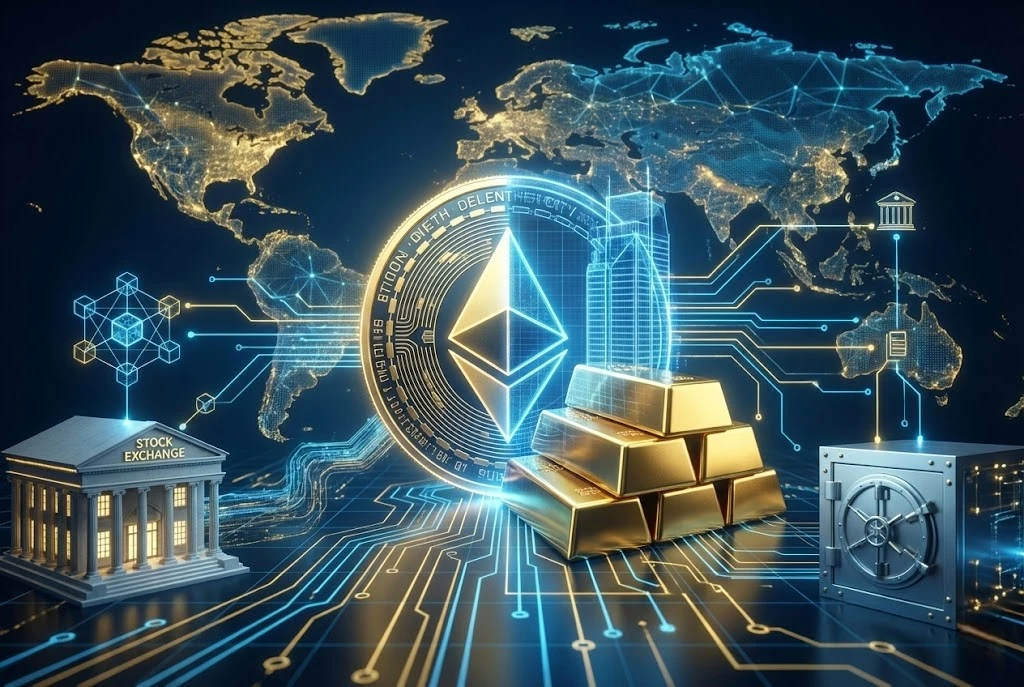
Real-World Asset (RWA) tokenization represents the intersection of two massive forces: a $300 trillion traditional finance market seeking efficiency, and blockchain infrastructure mature enough to handle institutional requirements. The question isn’t whether this happens. The question is which protocols capture the value.
After analyzing market structure, regulatory frameworks, technical architecture, and adoption metrics across 20+ RWA projects, three platforms have emerged as essential infrastructure: one bridging treasuries to DeFi, one providing the connectivity layer everything relies on, and one purpose-built for regulatory compliance from day one.
Understanding RWA Tokenization: Beyond the Hype
Before identifying winning projects, understand what’s actually happening.
What RWA Tokenization Solves
Traditional asset ownership and transfer remains remarkably inefficient. When you buy a stock, settlement takes T+2 (two days). Real estate transactions require weeks of paperwork, multiple intermediaries, and significant friction costs. Cross-border asset transfers face even worse inefficiencies—days of processing, multiple currency conversions, and fees at every step.
Tokenization attacks these inefficiencies directly:
Instant Settlement
Blockchain transactions settle in seconds or minutes, not days. When BlackRock’s BUIDL fund executes a transaction, ownership transfers immediately. No waiting for clearing houses, no settlement risk, no counterparty exposure during the lag.
Fractional Ownership
A $50 million Manhattan apartment becomes accessible to retail investors owning $1,000 fractions. A rare artwork worth $10 million can have 10,000 owners each holding $1,000 shares. This unlocks liquidity in previously illiquid markets.
24/7 Markets
Traditional markets close. Blockchains don’t. Tokenized assets trade continuously. When news breaks at 2 AM, holders can react immediately rather than waiting for market open.
Programmable Compliance
Smart contracts enforce regulatory requirements automatically. KYC verification, accredited investor checks, and transfer restrictions become code, not paperwork. This reduces compliance costs while increasing reliability.
Transparent Ownership
Blockchain records provide immutable proof of ownership. Real estate title disputes—which cost billions annually—become impossible. Every transaction, every owner, every encumbrance exists on-chain, verifiable by anyone.
The Market Opportunity: $16 Trillion by 2030
Boston Consulting Group estimates the tokenized asset market will reach $16 trillion by 2030. That’s conservative. It assumes 5-10% of traditional finance migrates to blockchain infrastructure within four years.
The total addressable market:
- Global real estate: $280 trillion
- Global bonds: $130 trillion
- Global equities: $100 trillion
- Commodities market: $20 trillion
- Art and collectibles: $2 trillion
Even 2% tokenization of these markets represents $10+ trillion in on-chain value.
Why Now? The Maturation Threshold
Previous tokenization attempts failed because infrastructure wasn’t ready. 2017’s ICO boom collapsed partly because Ethereum couldn’t handle the load. 2020’s DeFi summer showed promise but lacked regulatory clarity.
2024-2026 represents the maturation threshold:
Regulatory Clarity
MiCA (Markets in Crypto-Assets) took effect in Europe 2024. The U.S. SEC approved spot Bitcoin ETFs, signaling regulatory acceptance. Stablecoin legislation progressed. While imperfect, regulatory frameworks exist where none did before.
Infrastructure Maturity
Layer 2 solutions make Ethereum transactions cost pennies. Cosmos enables interoperability. Custody solutions meet institutional standards. The technical capability to handle trillions in tokenized assets exists today.
Institutional Adoption
BlackRock, JPMorgan, Citibank, and HSBC aren’t exploring tokenization—they’re deploying it. When every major financial institution builds blockchain infrastructure, the question shifts from “if” to “how fast.”
Yield Environment
With interest rates elevated, tokenized treasuries offering 5% yields become compelling. Ondo Finance’s products grew from $0 to $500M in 18 months purely because they offered regulatory-compliant yield in a high-rate environment.
The Three Essential RWA Infrastructure Plays
Dozens of projects claim to be “building RWA infrastructure.” Three have achieved product-market fit and institutional adoption.
1. Ondo Finance – The Treasury Bridge
Founded: 2021
Token: $ONDO
Market Cap: $2.1B (Feb 2026)
TVL: $500M+ in tokenized products
Key Product: USDY (yield-bearing stablecoin backed by short-term treasuries)
Ondo Finance solved a specific problem: how do crypto-native investors access treasury yields without leaving blockchain infrastructure? Their answer: tokenize the treasuries directly.
How It Works
USDY represents ownership in a portfolio of U.S. Treasury bills and overnight repos. When you hold USDY, you’re not just holding a stablecoin—you’re holding a share in government bonds. The yield (currently ~5% APY) accrues automatically to your wallet.
The infrastructure:
- Institutional investors deposit USDC
- Ondo’s legal structure (regulated fund) purchases treasuries
- Investors receive USDY tokens representing shares
- Yield accrues daily, compounded on-chain
- Redemption converts USDY back to USDC (T+1 settlement)
Why This Matters
Stablecoins like USDC represent $150 billion in crypto markets. That capital historically earned 0% yield. Ondo Finance converts idle stablecoin holdings into yield-generating assets while maintaining blockchain-native benefits (instant transfer, composability with DeFi protocols, transparent reserves).
The institutional validation:
- BlackRock BUIDL serves as underlying for Ondo products
- Tokenized through regulated fund structures
- Fully compliant with SEC money market fund regulations
- Custody by institutional-grade providers
The Competitive Moat
Ondo’s advantage isn’t technology—it’s legal structure and regulatory compliance. Building blockchain infrastructure is relatively easy. Building compliant legal wrappers that satisfy SEC requirements while maintaining blockchain benefits? That’s the moat.
Competitors attempting to offer similar products face years of regulatory approval. Ondo spent 2021-2023 building these frameworks. By 2026, they’re the established player with proven products and institutional relationships.
Tokenomics and Investment Thesis
$ONDO token mechanics:
- Governance over protocol parameters
- Fee sharing from protocol revenue (2.5% annual management fee on TVL)
- Potential staking mechanisms in development
Investment case:
- Bull scenario: If tokenized treasuries reach $100B market (20x growth), Ondo captures 30% share, TVL = $30B. At 2.5% fees, that’s $750M annual revenue. Token value depends on governance rights to that revenue stream.
- Bear scenario: Regulatory changes restrict tokenized treasuries, limiting growth. Competition from traditional finance (Fidelity, Vanguard tokenizing funds) reduces market share.
Current metrics suggest early-stage adoption. The product works, institutions use it, and regulatory moat provides defensibility. Risk lies primarily in regulatory changes or competition from better-capitalized traditional finance players.
2026 Outlook
Ondo’s roadmap includes:
- Tokenized corporate bonds
- Tokenized equities
- International treasury products (EU, UK government bonds)
- Integration with major DeFi protocols (Aave, Compound) as collateral
If executed, Ondo becomes the primary bridge between TradFi fixed income and DeFi yield markets.
2. Chainlink – The Universal Verification Layer
Founded: 2017
Token: $LINK
Market Cap: $15.8B (Feb 2026)
Integration: 2,000+ projects across 15+ blockchains
Key Product: CCIP (Cross-Chain Interoperability Protocol) + Proof of Reserve
Chainlink started as “the oracle problem” solution—how do smart contracts access real-world data reliably? By 2026, they’ve become something bigger: the verification and connectivity layer every RWA project requires.
The Architecture That Everything Relies On
RWA tokenization faces a fundamental challenge: blockchain transactions are deterministic and final, but real-world assets exist off-chain. How do you prove a tokenized gold token actually represents physical gold in a vault? How do you verify a real estate token corresponds to a deed?
This is where Chainlink’s infrastructure becomes essential.
Proof of Reserve (PoR)
Chainlink’s PoR provides cryptographic proof that off-chain assets back on-chain tokens. Here’s how it works for tokenized gold:
- Gold bars sit in a vault (off-chain)
- Custodian reports holdings to Chainlink network
- Chainlink nodes verify the report independently (multiple sources, cross-referencing)
- Verified data publishes on-chain
- Smart contract mints tokens only if reserves proven
This prevents the fraud that plagued previous attempts at asset-backed tokens. Remember Tether’s early days? Questionable reserve proof undermined trust. Chainlink makes reserve verification cryptographically verifiable and continuously updated.
Major implementations:
- PAXG (Paxos Gold): Uses Chainlink PoR to verify physical gold backing
- Synthetix: Verifies collateralization ratios
- TrueUSD: Proves bank account balances match token supply
Cross-Chain Interoperability Protocol (CCIP)
The future of tokenized assets isn’t single-chain—it’s multi-chain. A real estate token might originate on Ethereum but need to transfer to Polygon for lower fees, then to Base for specific DeFi integrations.
CCIP provides the secure messaging layer enabling this:
- Message passing: Send instructions across chains
- Token transfers: Move tokenized assets between networks
- Programmable transfers: Execute complex multi-chain transactions atomically
Think of CCIP as SWIFT for blockchains. When JPMorgan’s MONY fund needs to interact with Ethereum DeFi protocols, then move to an L2 for efficiency, CCIP handles the routing securely.
Why Banks Actually Need Chainlink
Traditional finance doesn’t trust single points of failure. When building tokenization infrastructure, banks require:
- Decentralized verification (no single oracle controls data)
- Established track record (Chainlink has operated since 2017)
- Security audits (continually audited by top firms)
- Insurance ($1B+ in economic security through staking)
Chainlink provides these requirements. Alternative oracle solutions lack the track record, security, or decentralization that institutional requirements demand.
The Network Effect Moat
Chainlink’s competitive advantage compounds: more projects integrate Chainlink → more data sources connect → network becomes more valuable → more projects integrate. This creates switching costs. A project using Chainlink for price feeds, PoR, and CCIP can’t easily switch to an alternative without rebuilding multiple integrations.
By 2026, Chainlink touches 89% of DeFi TVL through some integration. For RWA specifically:
- Ondo Finance uses Chainlink price feeds
- Major stablecoin issuers use PoR
- Cross-chain RWA transfers rely on CCIP
Tokenomics and Investment Thesis
$LINK token mechanics:
- Payment for oracle services (data providers stake LINK as collateral)
- Staking yields from network fees (v0.2 staking launched 2024)
- Security collateral (slashing for malicious behavior)
Investment case:
- Bull scenario: RWA tokenization scales to $10T. Every project requires oracle services. Chainlink captures 70% market share. At 0.1% fee on verified value, that’s $7B annual revenue flowing through LINK token economics.
- Bear scenario: Competitor oracles (API3, Pyth) capture market share. Centralized solutions prove “good enough” for institutions. Network fees don’t accrue sufficient value to token holders.
The key question: does Chainlink’s network effect prove durable, or do alternatives fragment the market? Evidence through early 2026 suggests Chainlink’s lead is strengthening, not weakening.
2026 Outlook
Chainlink’s roadmap includes:
- CCIP expansion to all major L1s and L2s
- Private transactions (financial institutions need confidential settlement)
- Programmable security (dynamic oracle behaviors based on market conditions)
- Direct SWIFT integration for TradFi messaging
If executed, Chainlink becomes the standard middleware layer between traditional finance and blockchain infrastructure.
3. Mantra – The Compliance-Native L1
Founded: 2020
Token: $OM
Market Cap: $6.2B (Feb 2026)
Architecture: Cosmos SDK-based L1 with built-in compliance
Key Feature: Protocol-level KYC/AML enforcement
Most blockchains face a fundamental problem for institutional adoption: they’re permissionless. Anyone can interact with Ethereum or Solana smart contracts. For meme coins and DeFi, that’s fine. For tokenized securities and real estate? Regulators demand restrictions.
Mantra recognized this gap early and built a blockchain specifically designed for regulated asset tokenization.
How Compliance-Native Design Works
Traditional approach: build tokens on Ethereum, add compliance through smart contract logic. Problem: smart contracts are complex, security vulnerabilities exist, and retrofitting compliance creates attack surfaces.
Mantra’s approach: bake compliance into the protocol itself.
Protocol-Level KYC
Every Mantra address connects to a verified identity. Before transacting, users complete KYC through regulated providers. The blockchain itself enforces these requirements—not smart contracts, not applications, but the base layer.
Features:
- Mandatory identity verification before any transaction
- Geographic restrictions (certain assets available only to specific jurisdictions)
- Investor accreditation checks (automated verification of income/net worth requirements)
- Transfer restrictions (security tokens can only move between verified holders)
This sounds restrictive compared to Ethereum’s permissionless design. That’s the point. Banks and asset managers can’t tokenize billions in securities on permissionless chains—compliance requirements make it legally impossible. Mantra provides the infrastructure they actually need.
The Technical Architecture
Built on Cosmos SDK, Mantra inherits several advantages:
Interoperability
Cosmos’s Inter-Blockchain Communication (IBC) protocol enables secure communication with other Cosmos chains. A tokenized real estate fund on Mantra can interact with DeFi protocols on other IBC-compatible chains while maintaining compliance.
Performance
Cosmos chains achieve 10,000+ transactions per second with sub-second finality. For institutional settlement, this performance proves critical. Traditional finance settlement happens in milliseconds—blockchain infrastructure must match.
Customizability
Cosmos SDK allows deep protocol customization. Mantra modified consensus mechanisms, transaction processing, and governance to meet regulatory requirements. This level of customization isn’t possible on general-purpose chains.
Sovereignty
As an independent L1, Mantra controls its entire stack. Regulatory changes don’t require coordinating with Ethereum governance or convincing Solana developers. If regulators mandate new KYC requirements, Mantra implements them directly.
Real-World Implementations
Early adoption focuses on three asset classes:
Real Estate Tokenization
Multiple property tokenization projects launched on Mantra in 2024-2025. Examples include:
- $50M Dubai property fractionally tokenized (minimum investment $1,000)
- London office building tokenization enabling instant settlement
- U.S. residential real estate portfolios with built-in rental yield distribution
Private Equity and Venture Capital
Traditional PE funds have 7-10 year lockups with limited liquidity. Tokenization creates secondary markets while maintaining accredited investor restrictions:
- PE fund tokens trade between qualified investors
- Automated compliance checks every transaction
- Smart contracts handle quarterly distributions
Tokenized Bonds
Corporate and municipal bonds issued directly on Mantra:
- Automated coupon payments
- Instant settlement reducing counterparty risk
- Transfer restrictions ensuring only approved holders participate
The Regulatory Moat
Mantra’s competitive advantage is regulatory approval. Multiple jurisdictions (Dubai, Singapore, EU member states) granted permission for regulated securities issuance on Mantra specifically because of built-in compliance features.
Competitors attempting to replicate this face years of regulatory discussions. Mantra’s early start provides a significant moat—not technical, but legal and regulatory.
Tokenomics and Investment Thesis
$OM token mechanics:
- Staking for network security (validators bond $OM)
- Governance over protocol parameters
- Fee payment for transactions (discounts for $OM holders)
- Collateral for synthetic assets
Investment case:
- Bull scenario: Regulatory clarity drives institutional adoption. Trillions in tokenized securities require compliance-native infrastructure. Mantra captures significant market share as the “institutional blockchain.” Network fees and staking demand drive token value.
- Bear scenario: Traditional finance builds private, permissioned blockchains instead (like JPMorgan’s Onyx). Mantra’s public but compliant model loses to fully private alternatives. Competition from other compliance-focused chains fragments market.
The key question: will institutions prefer public-but-compliant chains (Mantra’s model) or private permissioned networks? Early evidence suggests demand exists for both—Mantra for assets requiring some public market liquidity, private chains for purely institutional settlement.
2026 Outlook
Mantra’s roadmap includes:
- Additional regulatory approvals (targeting U.S., Japan, South Korea)
- Enhanced privacy features (zero-knowledge proofs for confidential transactions)
- Integration with TradFi infrastructure (direct SWIFT messaging, clearinghouse connections)
- Institutional custody partnerships
If executed, Mantra becomes the default platform for regulated securities tokenization outside fully private networks.
Investment Strategies: Risk-Adjusted Approaches
These aren’t meme coins. RWA plays require different investment frameworks.
Conservative Allocation (5-10% of crypto portfolio)
Profile: Capital preservation priority, seeking steady growth, 3-5 year horizon
Allocation:
- 70% Chainlink ($LINK) – Established network effect, lowest risk
- 30% Ondo Finance ($ONDO) – Yield-focused, regulatory clarity
Rationale: Chainlink operates profitably with strong adoption. Risk lies primarily in competitive dynamics, not project viability. Ondo has proven demand and regulatory approval. Both have institutional backing.
Entry Strategy: Dollar-cost average over 3-6 months. Don’t attempt timing—focus on accumulation.
Take Profit: Consider selling 25% on 3x gains, letting rest run for longer-term appreciation.
Moderate Allocation (10-20% of crypto portfolio)
Profile: Growth-focused, willing to accept volatility, 2-4 year horizon
Allocation:
- 40% Chainlink ($LINK) – Core infrastructure
- 35% Ondo Finance ($ONDO) – Treasury yield play
- 25% Mantra ($OM) – Regulatory bet with higher risk/reward
Rationale: Balanced exposure to different aspects of RWA infrastructure. Chainlink provides stability, Ondo captures treasury tokenization growth, Mantra offers upside if compliance-native design proves essential.
Entry Strategy: 50% initial position, 25% on market weakness, 25% held for additional opportunities.
Take Profit: Trim 30% on 2-3x, hold remainder for potential 10x in full bull scenario.
Aggressive Allocation (20-30% of crypto portfolio)
Profile: Maximum growth priority, high risk tolerance, 1-3 year horizon
Allocation:
- 30% Chainlink ($LINK) – Stability anchor
- 30% Ondo Finance ($ONDO) – Growth driver
- 40% Mantra ($OM) – High-risk high-reward
Rationale: Overweight the highest potential return (Mantra) while maintaining exposure to more established plays. This portfolio bets heavily on compliance-native infrastructure proving essential.
Entry Strategy: 60% deployed immediately, 40% reserved for averaging down during market corrections.
Take Profit: Full risk-on approach—hold until clear bull market top signals (institutional adoption plateaus, valuations reach extremes).
Position Sizing Framework
Regardless of approach, apply risk management:
Maximum Position Size
- Per token: 10% of crypto portfolio maximum
- Total RWA exposure: 30% of crypto portfolio maximum
- Crypto as whole: Should not exceed 15-20% of total net worth
Rebalancing Triggers
- Monthly rebalancing if any position deviates 25%+ from target
- Quarterly full portfolio review
- Immediate rebalancing if any token 3x’s (lock in some gains)
Stop Loss Considerations
Traditional stop losses make less sense for infrastructure plays. Consider instead:
- Fundamental stop: Exit if key partnerships dissolve or regulatory approval revoked
- Time stop: If thesis hasn’t played out in 18 months, reconsider allocation
Risks and Challenges: What Could Go Wrong
Institutional enthusiasm creates narrative momentum. But real risks exist.
Regulatory Risk: The Primary Threat
Governments could restrict or ban tokenization. While increasingly unlikely given institutional adoption, regulatory changes remain the highest risk:
Potential scenarios:
- Securities laws expand to require all tokenized assets trade on regulated exchanges only
- KYC requirements become so onerous that blockchain benefits disappear
- Jurisdictional fragmentation creates compliance complexity exceeding traditional finance
Mitigation: Diversify across projects with different regulatory strategies. Chainlink is jurisdictionally neutral. Ondo operates within U.S. regulatory framework. Mantra targets multiple jurisdictions.
Competition from Traditional Finance
Why would BlackRock, Fidelity, or Vanguard use Ondo, Chainlink, or Mantra? They could build proprietary infrastructure.
This is happening. JPMorgan has Onyx. HSBC has Orion. Major institutions are building private blockchains.
The question: Will open protocols (like Ethereum) or closed networks (like Onyx) win the tokenization race?
Current evidence: Both will exist. Fully private assets (proprietary institutional settlement) use permissioned networks. Assets requiring some public liquidity (retail-accessible funds, fractional real estate) need public infrastructure.
Chainlink, Ondo, and Mantra play in the latter category. Risk exists if that category never reaches meaningful scale.
Technical Risks: Smart Contract Vulnerabilities
Tokenizing trillions creates massive incentives for attacks. Smart contract bugs, oracle manipulation, or bridge exploits could cause catastrophic losses.
Mitigation:
- Stick to audited protocols with track records
- Never hold maximum positions on any single platform
- Understand that code risk never fully disappears
Liquidity Risk: Exit Strategy Uncertainty
These tokens may have limited liquidity during bear markets. $LINK has deep liquidity. $ONDO and $OM significantly less.
During crashes, spreads widen and exits become difficult. Plan for this:
- Don’t over-allocate capital you might need urgently
- Set targets in advance rather than emotion-driven selling
- Consider liquidity when sizing positions (smaller positions for less liquid tokens)
Frequently Asked Questions
What exactly is RWA tokenization?
Real-World Asset tokenization converts ownership of physical or financial assets into blockchain tokens. Instead of paper stock certificates or property deeds, ownership exists as tokens on a blockchain. This enables 24/7 trading, fractional ownership, instant settlement, and programmable compliance.
Are RWA tokens legal?
Yes, but regulatory frameworks vary by jurisdiction. In the U.S., tokenized securities must comply with SEC regulations (Regulation D for private placements, Regulation A+ for public offerings). In Europe, MiCA provides comprehensive framework. Most legitimate RWA projects operate within regulatory boundaries and obtain necessary licenses.
How do I buy RWA tokens like $ONDO, $LINK, and $OM?
All three trade on major centralized exchanges:
- Binance, Coinbase, Kraken (for $LINK)
- Binance, OKX, KuCoin (for $ONDO and $OM)
Always use reputable exchanges. See our crypto exchange guide for detailed comparisons.
What are the tax implications?
In most jurisdictions, RWA tokens are taxed like other crypto assets:
- Capital gains tax on profits when sold
- Income tax on yields (like Ondo’s treasury yields)
- Different rates for short-term (<1 year) vs. long-term holdings
Consult a tax professional familiar with crypto. Regulations continue evolving.
How is this different from traditional stocks or bonds?
Key differences:
- Settlement: Instant vs. T+2 for stocks
- Trading hours: 24/7 vs. market hours
- Fractional ownership: Easy vs. limited
- Composability: Can be used as DeFi collateral
- Transparency: On-chain records vs. centralized ledgers
Main tradeoff: traditional assets have deeper liquidity and longer regulatory track record.
What’s the time horizon for RWA adoption?
Meaningful scale: 2-4 years
Mass adoption: 5-10 years
Early signs already exist (BlackRock BUIDL, JPMorgan MONY), but trillions in migration will take time. Institutions move slowly, regulatory clarity takes years, and infrastructure needs continued maturation.
What’s the biggest risk?
Regulatory changes. If major jurisdictions ban or severely restrict tokenization, the thesis breaks. However, with BlackRock, JPMorgan, and others committed, regulatory opposition seems increasingly unlikely. The bigger question is speed and form of adoption, not whether it happens.
Should I invest in RWA tokens or traditional RWA funds?
Depends on profile:
- Invest in tokens if: You want speculative upside, believe in crypto infrastructure, can handle volatility
- Invest in funds if: You want stable yields, prioritize capital preservation, prefer regulated structures
Many investors do both—traditional RWA funds for stability, RWA protocol tokens for growth.
How do I evaluate new RWA projects?
Framework for assessment:
- Regulatory compliance: Licensed? Operating within legal frameworks?
- Partnerships: Working with major institutions or custodians?
- Technical audits: Smart contracts audited by reputable firms?
- Traction: Real usage or just announcements?
- Team: Experienced in both finance and crypto?
- Token design: Clear value accrual or vague “governance”?
Most projects fail on criteria 1, 2, and 4. Be ruthless in evaluation.
The Bottom Line: RWA as Crypto’s Next Chapter
The narrative around cryptocurrency has shifted. 2021 was about DeFi summer and NFT mania. 2022 was about survival through the bear market. 2023-2024 was about ETF approvals and institutional legitimacy.
2025-2026 is about RWA—the convergence of traditional finance’s capital with blockchain’s infrastructure.
This isn’t speculative technology anymore. BlackRock operates blockchain funds. JPMorgan settles payments on-chain. Siemens issues tokenized bonds. The experiment phase ended. The deployment phase has begun.
The protocols that win this transition—the infrastructure that trillions of tokenized assets settle on—will create enormous value. Chainlink, Ondo, and Mantra aren’t the only players. But they’ve achieved what most projects haven’t: actual adoption, institutional partnerships, and regulatory clarity.
The investment opportunity exists because most crypto participants still think in terms of meme coins and quick flips. While retail chases 100x gains on dog tokens, institutions quietly build infrastructure that will process trillions.
The strategic move: position early in the infrastructure layer before the asset explosion arrives. By the time $5 trillion in tokenized assets exists, infrastructure protocols will have already appreciated significantly.
Three years from now, the winning RWA protocols won’t be speculative bets. They’ll be established infrastructure as essential to finance as SWIFT or Visa are today.
The question for investors: do you want to own that infrastructure?
About This Analysis
Research Methodology: This analysis synthesizes publicly available data including project documentation, partnership announcements, regulatory filings, tokenomics specifications, and on-chain metrics. We maintain no paid relationships with any project mentioned.
Data Sources:
- Project official documentation and whitepapers
- Regulatory filings (SEC, MiCA compliance documents)
- On-chain analytics (DeFiLlama, Dune Analytics)
- Institution announcements (BlackRock, JPMorgan public statements)
- Industry research (BCG, McKinsey tokenization reports)
Last Updated: February 15, 2026
Authors: CryptoScopeLab Research Team
Contact: contact@cryptoscopelab.com
Risk Disclaimer
Cryptocurrency investments carry substantial risk. RWA tokens, while connected to traditional assets, remain highly volatile and subject to regulatory uncertainty. This analysis provides educational information only and does not constitute financial, investment, or legal advice.
Key Risks:
- Regulatory Risk: Government actions may restrict or prohibit tokenization
- Market Risk: Token prices exhibit extreme volatility unrelated to underlying asset value
- Technical Risk: Smart contract vulnerabilities, oracle failures, or protocol exploits
- Liquidity Risk: Inability to exit positions during market stress
- Competition Risk: Better-capitalized traditional finance players may dominate market
Always:
- Invest only capital you can afford to lose completely
- Conduct independent research beyond this analysis
- Consult qualified financial advisors before making investment decisions
- Understand that past performance does not guarantee future results
- Maintain diversified portfolios across multiple asset classes
The authors and CryptoScopeLab hold positions in cryptocurrencies discussed and may have conflicts of interest.
Related Guides
Looking to understand the broader crypto market? Check out these essential analyses:
- Best Crypto Exchanges 2026 – Where to buy RWA tokens safely
- Bitcoin Bottom Formation 2026 – Market context for RWA investments
- The ‘MicroStrategy of Ethereum’ – Institutional crypto accumulation strategies
- Bitcoin Mining vs AI Data Centers – Infrastructure and energy dynamics
- Top 5 ‘Sleeping Giant’ Altcoins – High-conviction crypto picks
- Bitcoin & Gold Liquidity Crisis – Understanding market dynamics
- Bull Trap or Reversal? – Market timing indicators
Questions about RWA investing or tokenization?
📧 Email: contact@cryptoscopelab.com
🐦 Twitter: @CryptoScopeLab
Found this guide helpful? Share it with fellow investors exploring the future of finance.