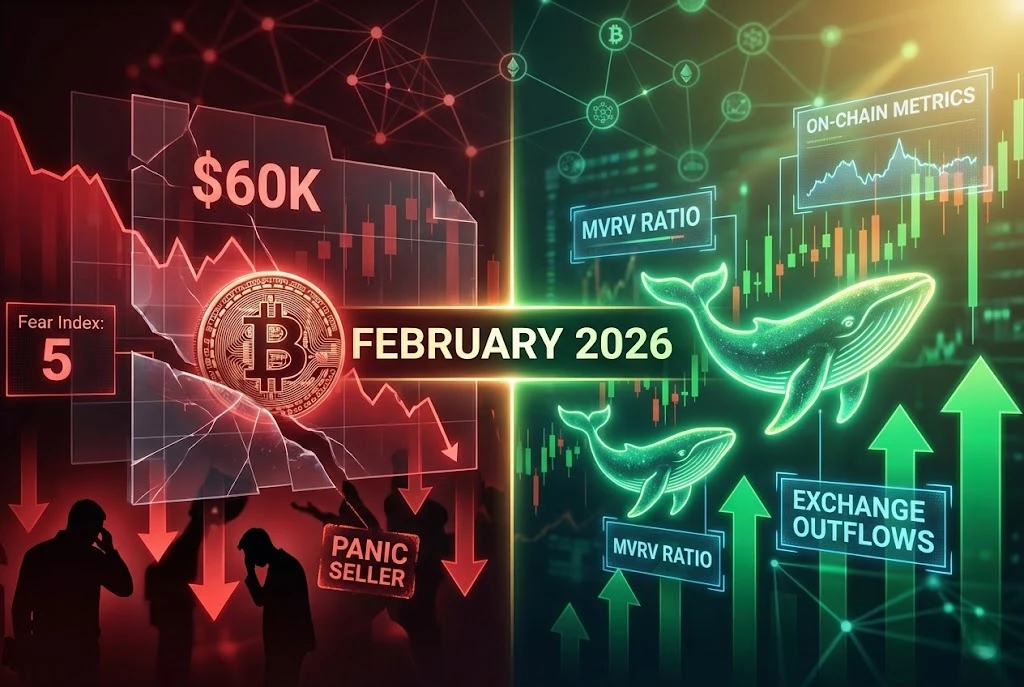
When Bitcoin crashed to $60,062 on February 6, 2026—a brutal 52% drop from its October 2025 all-time high of $126,000—retail investors did exactly what they always do during panic: they sold. But while social media filled with capitulation threads and liquidations crossed $2.5 billion in a single day, something extraordinary was happening beneath the surface.
The smart money was buying.
On the most fearful day in crypto sentiment history, whale wallets absorbed 66,940 BTC into accumulation addresses—the largest single-day whale accumulation since 2022. The Crypto Fear and Greed Index printed a historic low of 5, worse than the reading during the FTX collapse.
📅 Originally Published: February 15, 2026
🔄 Last Updated: February 17, 2026
This divergence between retail panic and institutional conviction isn’t just interesting—it could define the entire 2026-2027 cycle. Here’s why the on-chain data suggests we may be witnessing one of the most significant accumulation phases in Bitcoin’s history.
The Anatomy of Historic Fear
The Numbers Don’t Lie
The February 2026 selloff wasn’t just another correction. Multiple on-chain indicators converged at levels historically associated with generational buying opportunities:
Supply in Profit vs. Loss Convergence Bitcoin currently has 11.1 million BTC in profit and 8.9 million BTC underwater. When these two metrics converge—as they’re rapidly approaching—Bitcoin has historically formed definitive cycle bottoms. This pattern appeared in 2015 ($200), 2019 ($3,300), March 2020 ($3,000), and November 2022 ($15,000).
If convergence occurs at current cost basis levels, the implied spot price would be near $60,000—exactly where Bitcoin bottomed on February 6.
Circulating Supply in Loss The number of coins that last moved at prices higher than current levels surged to almost 10 million BTC. This is the fourth-highest level ever recorded, comparable only with the 2015, 2019, and 2022 bear market bottoms.
Long-term holders’ circulating supply at a loss reached 4.6 million BTC. At previous bear market lows, this figure exceeded 5 million BTC—suggesting this metric is approaching, but hasn’t yet fully matched, prior extremes.
The RSI Oversold Extreme Bitcoin hit the third most oversold reading in its 17-year history on the Relative Strength Index (RSI). Only two previous instances showed this level of technical overselling, both of which marked major cycle lows.
The Whale Accumulation Thesis
While retail fled, institutional players executed one of the most aggressive accumulation campaigns on record:
- 70,000+ BTC accumulated by whale wallets (1,000-100,000 BTC) in early February
- Worth approximately $4.6 billion at current prices
- The 30-day SMA of exchange whale outflows rose to 3.2%, a pattern that preceded the last bull market
- Over 387,930 BTC bought by large wallets in the 30 days ending February 15
The contrast is stark: retail investors saw a crypto winter. Institutional investors saw a clearance sale.
Why This Time Actually Is Different
1. ETF Infrastructure Changes Everything
The approval and maturation of Bitcoin spot ETFs has fundamentally altered market structure. Unlike previous cycles, there’s now a regulated on-ramp for institutional capital that didn’t exist during the 2018-2019 or 2022 bear markets.
Despite the recent outflows that began in mid-January 2026, the ETF infrastructure remains intact with:
- BlackRock’s IBIT holding approximately $53 billion in assets
- Cumulative trading volume exceeding $880 billion since launch
- Harvard Management Company increasing its IBIT position by 257% to $442.8 million
The temporary pause in weekly net inflows since mid-January signals institutional rebalancing rather than abandonment. These are sophisticated allocators managing volatility, not retail capitulation.
2. On-Chain Activity Tells a Bullish Story
Price dropped, but network fundamentals told a different narrative:
- Transaction volume hit November 2025 highs at ~$41 billion
- Daily active addresses spiked to 845,000—levels not seen since September 2025
- Bitcoin’s MVRV ratio (Market Value to Realized Value) fell to its lowest point since January 2023
The divergence between falling prices and rising on-chain activity suggests aggressive repositioning rather than a liquidity freeze. This is precisely the pattern that marks bottoms, not tops.
3. The Four-Year Cycle Is Breaking
Grayscale Research and other institutional analysts now argue that the traditional four-year Bitcoin cycle is ending. Here’s why:
- Regulatory clarity: 2025 saw the passage of stablecoin legislation and a complete regulatory shift in the U.S.
- Institutional infrastructure: ETPs, custody solutions, and prime brokerage services are now mature
- Corporate treasuries: Over 100 publicly traded companies now hold cryptocurrency on their balance sheets
The transition from a speculative retail-driven market to an institutionally-dominated one fundamentally alters cycle dynamics. Boom-bust volatility gives way to more sustained, less volatile appreciation as professional allocators replace retail speculators.
The Macro Context: Why Fear Was Rational
Understanding the February crash requires understanding the broader macroeconomic picture. As we analyzed in depth in our liquidity crisis report, Bitcoin and gold crashing together wasn’t a safe haven failure—it was a textbook dollar liquidity squeeze.
The Liquidity Crisis Framework
When the U.S. Dollar Index (DXY) spiked above 110 in early February, it signaled a global rush for dollars. In liquidity crises, everything sells off initially because investors need cash to meet margin calls and redemptions. Only after the dust settles do safe havens rally.
Key macro triggers included:
- Japan’s 10-year bond yields hitting 1.5%, the highest since 2011
- NATO tariff announcements creating trade war fears
- U.S. 2-year Treasury yields approaching August 2022 lows, pricing in aggressive rate cuts
- World Uncertainty Index surging above 100,000 in late 2025
Bitcoin fell within a broader risk-off regime. But unlike 2022, when crypto-specific contagion (FTX, Terra/Luna) drove selling, this was purely macro. No exchanges failed. No protocols collapsed. The infrastructure held.
What History Suggests Happens Next
The Post-Capitulation Playbook
Previous Bitcoin cycles show a consistent pattern after extreme fear readings:
2015 Bottom ($200)
- Fear and Greed Index: 8
- Time to recovery: 14 months
- Bull market peak: $19,700 (2017)
- Return from bottom: 9,750%
2019 Bottom ($3,300)
- Fear and Greed Index: 10
- Time to recovery: 8 months
- Bull market peak: $69,000 (2021)
- Return from bottom: 1,991%
2022 Bottom ($15,000)
- Fear and Greed Index: 6 (FTX collapse)
- Time to recovery: 11 months
- Bull market peak: $126,000 (October 2025)
- Return from bottom: 740%
The February 6, 2026 reading of 5 on the Fear and Greed Index was worse than the FTX collapse. If historical patterns hold, this marks a generational entry point—though recovery may not be immediate.
The Consolidation Phase
Analysts increasingly expect a consolidation phase rather than a V-shaped recovery. CryptoQuant’s data shows:
- ETF flows normalizing but not surging
- Derivatives markets showing healthy deleveraging
- Funding rates returning to neutral after extreme negativity
This suggests Bitcoin may trade in a $60,000-$80,000 range for several months while building a base. The “boring” accumulation phase that precedes explosive rallies.
The Ethereum Wildcard
The MicroStrategy of Ethereum Emerges
While Bitcoin grabbed headlines, a seismic shift occurred in Ethereum markets. As detailed in our Bitmine accumulation analysis, Bitmine Immersion Technologies (BMNR) quietly became what many are calling “the MicroStrategy of Ethereum.”
Their aggressive accumulation strategy:
- $13 billion in Ethereum holdings
- Over 30% staking rate achieved across the network in February 2026
- 36 million ETH now staked, securing approximately $120 billion in value
Ethereum’s transformation into a security settlement layer—as proposed by Vitalik Buterin—is attracting institutional capital. 21Shares announced quarterly staking reward distributions for its spot Ethereum ETF (TETH), marking the first time ETF investors can capture validator rewards without operating infrastructure.
The JPMorgan Validation
JPMorgan’s launch of its MONY tokenized money market fund directly on Ethereum mainnet in February 2026 represents powerful validation of the security settlement layer thesis. This connects directly to the broader RWA tokenization trend reshaping institutional finance.
When TradFi giants like JPMorgan choose Ethereum over alternatives for critical infrastructure, it’s not a short-term trade—it’s a 10-year thesis.
Critical Metrics to Watch
For those tracking whether the bottom is in, monitor these indicators:
1. Realized Profit/Loss Ratio (90-Day SMA)
Historically, strong upside phases only emerged once this ratio rose above the 5.0 threshold. Currently sitting below this level, watch for sustained movement above 5.0 to confirm fresh capital entering the market.
2. Exchange Balances
If ETF inflows occur while exchange ETH and BTC balances fall, it signals reduced sell-side liquidity—a bullish sign. If both rise together, ETF demand is being offset by selling elsewhere.
3. Net Realized Loss Levels
Bitcoin’s Net Realized Loss hit extreme levels at $13.6 billion on February 6. The 2022 loss peak occurred five months before the actual bear market bottom. If this pattern repeats, a bottom could form around July 2026.
4. Long-Term Holder Net Position Change
LTH net-position change shows extreme distribution, with 245,000 BTC exiting long-term holders by early February. If this metric stabilizes or reverses, it signals capitulation is complete.
5. Altcoin Season Index
Currently sitting at 25/100, firmly in “Bitcoin Season” territory. Only when this index rebounds above 40 and holds for several weeks does altcoin season typically follow—usually within one quarter.
The Bear Case: Why $40K Remains Possible
Intellectual honesty requires acknowledging the bearish scenario:
The Q4 2026 Bottom Theory
Multiple analysts forecast Bitcoin could extend its downtrend to $40,000-$50,000 between mid-September and late November 2026. Their thesis:
- Previous bear cycles (2018, 2022) printed lows 12 months after the bull market top
- Bitcoin’s October 2025 ATH suggests a late 2026 bottom
- The Net Realized Loss peak occurred in early February, but the 2022 pattern showed the actual bottom came 5 months later
This would represent an additional 33% drop from current levels.
The Macro Wildcard
If the global economy enters recession in late 2026, all risk assets could face additional pressure. Bitcoin has never been tested in a true economic downturn with its current level of institutional ownership.
The counterargument: institutional holders have longer time horizons and deeper conviction than retail. They’re less likely to panic sell during a recession.
Investment Implications: Strategy for Different Profiles
For Long-Term Holders
The on-chain data suggests this is an accumulation zone. Strategies:
- Dollar-cost averaging through the $60K-$80K range
- Focus on both BTC and ETH given the institutional narrative shift
- Patience for 6-12 month consolidation before expecting significant upside
- Target 2027 for next major bull market peak based on institutional adoption timeline
To execute this strategy, ensure you’re using a secure, low-fee exchange. See our complete crypto exchange comparison for 2026’s best options.
For Active Traders
- Watch for failed rallies at resistance ($76,971 on BTC)
- Support levels: $60,000-$62,000 (BTC), $1,800-$2,000 (ETH)
- Consider the risk of another leg down to $40K before committing full position size
- Monitor derivatives metrics: funding rates, open interest, options skew
For indicator framework, review our Bull Trap vs. Reversal analysis to understand the key signals separating genuine recoveries from traps.
For Risk-Averse Allocators
- Wait for sustained ETF inflows to return (3+ weeks of positive flows)
- Wait for Realized Profit/Loss Ratio to confirm above 5.0
- Consider starting with a 2-3% allocation and increasing if metrics confirm bottom
- Diversify across BTC, ETH, and quality infrastructure plays like those in our RWA token guide
The 2026-2027 Outlook: Three Scenarios
Bull Case (40% probability)
- Bottom is in at $60K
- Consolidation through Q2 2026
- New ATH by Q4 2026 or Q1 2027
- Target: $150,000-$200,000
Catalysts: Regulatory clarity, sustained ETF inflows, corporate treasury adoption accelerating
Base Case (45% probability)
- Range-bound $60K-$80K through mid-2026
- Retest of lows but hold above $55K
- Recovery begins Q4 2026
- New ATH in 2027
- Target: $120,000-$150,000
Catalysts: Gradual macro improvement, institutional accumulation continues
Bear Case (15% probability)
- Lower low to $40K-$50K by Q4 2026
- Extended consolidation through early 2027
- Recovery dependent on macro stabilization
- New ATH delayed to late 2027 or 2028
- Target: $100,000-$130,000
Catalysts: Global recession, regulatory setbacks, loss of institutional confidence
The Structural Shift: From Speculation to Infrastructure
Perhaps the most important takeaway from the February 2026 crash isn’t the price action—it’s what it revealed about the new market structure.
The Maturation Markers
- Revenue focus over TVL: DeFi protocols now highlighting profits and buybacks, not just locked capital
- Quality over quantity: Only 11% of altcoins trading above their 50-day MA; weak projects getting washed out
- Institutional custody: Serious allocators require regulated custody and insurance
- Yield generation: Staking ETFs and on-chain yields becoming mainstream expectations
This isn’t the Wild West crypto of 2017 or even 2021. It’s the early stages of a legitimate alternative asset class. The AI and mining infrastructure pivot happening simultaneously reinforces this maturation—crypto infrastructure is becoming serious business.
The DeFi Evolution
Total DeFi TVL sits around $130-$140 billion in early 2026, up from a post-FTX low near $50 billion but still below peak bull market levels. The market is projected to grow to:
- $60.73 billion in 2026 (market size, not TVL)
- $256.4 billion by 2030
- 43.3% CAGR between 2026-2030
Institutional lending protocols like Maple Finance grew from $500M to over $4B in TVL, targeting the prior CeFi lending peak of $69B. This is infrastructure-building, not speculation.
Conclusion: Buying Fear, Selling Greed
The February 2026 capitulation created precisely the conditions that have historically marked generational buying opportunities:
- ✅ Extreme fear (index of 5)
- ✅ Massive whale accumulation (66,940 BTC in one day)
- ✅ Supply in profit/loss convergence approaching
- ✅ Long-term holder capitulation
- ✅ Network activity diverging positively from price
- ✅ Mature institutional infrastructure in place
- ✅ No crypto-specific contagion (unlike 2022)
The difference between successful investors and the crowd is simple: the crowd buys euphoria and sells panic. Successful investors do the opposite.
Warren Buffett’s maxim rings especially true today: “Be fearful when others are greedy, and greedy when others are fearful.”
On February 6, 2026, when the Fear and Greed Index hit 5, the market was screaming fear. The whales were buying. History suggests you should have been too.
Key Takeaways
🔑 Historic bottom formation: Multiple on-chain indicators suggest February 6, 2026 marked a generational buying opportunity comparable to 2015, 2019, and 2022 lows.
🐋 Whale vs. retail divergence: Institutional players accumulated 70,000+ BTC while retail panicked, the classic “smart money” pattern.
📊 New market structure: ETF infrastructure, corporate treasuries, and institutional custody have fundamentally changed Bitcoin’s market dynamics.
⏰ Patience required: Historical patterns suggest 6-12 months of consolidation before significant upside, not immediate V-shaped recovery.
🎯 Multi-scenario planning: Allocate based on conviction but maintain flexibility for range-bound markets or potential retest of lows.
Frequently Asked Questions
Why did Bitcoin and Gold crash together if they’re both safe havens?
Safe haven assets only perform their role AFTER liquidity crises stabilize. In the initial panic, everything sells off as investors rush to raise cash (U.S. dollars). Historical examples include March 2020 and September 2008, where gold dropped 12-15% before rallying. The February 2026 pattern follows this exact playbook. For a deeper explanation, read our full liquidity crisis analysis.
Is this worse than the 2022 bear market?
No. The 2022 crash involved crypto-specific contagion (FTX collapse, Terra/Luna implosion, Celsius bankruptcy). February 2026 is purely macro-driven—no exchanges failed, no protocols collapsed. Infrastructure held strong. This actually makes it healthier; it’s a washout, not a systemic crisis.
Should I sell everything and wait?
Selling after a 52% crash means locking in losses. Every historical bottom looked scary at the time. Investors who sold at $3,300 (2019), $15,000 (2022), or $4,500 (2020) regretted it. If you can’t handle volatility, crypto might not be appropriate—but selling at the bottom is the worst decision.
Are altcoins a better buy here?
Bitcoin typically leads recoveries. Altcoins lag 2-4 months. Buying altcoins at macro bottoms is risky—they drop another 30-50% even after Bitcoin stabilizes. Focus on BTC and ETH first. Only after Bitcoin reclaims $80K should you consider quality altcoins. For a screened list of fundamentally strong projects, see our Sleeping Giant Altcoins guide.
What about Ethereum?
Ethereum has unique catalysts: institutional accumulation (Bitmine’s $13B), staking ETFs launching, and JPMorgan’s MONY tokenized fund on mainnet. ETH staking rate hit 30% in February 2026, removing supply from markets. Risk/reward may actually be better than Bitcoin in this cycle. Read our full Bitmine Ethereum analysis for the detailed institutional thesis.
How do I know when the bottom is confirmed?
Watch these signals:
- DXY drops below 108 ✅
- 3+ weeks of positive ETF inflows ✅
- Bitcoin reclaims $75,000 resistance ✅
- Fear & Greed Index above 40 for 2+ weeks ✅
- Realized Profit/Loss Ratio above 5.0 ✅
When 4/5 trigger, the bottom is likely confirmed. For ongoing indicator tracking, follow our Bull Trap vs. Reversal analysis.
About This Analysis
Research Methodology: This analysis synthesizes on-chain data, ETF flow data, and macroeconomic indicators. All metrics current as of February 15, 2026.
Data Sources: CryptoQuant, Glassnode, Santiment, CoinGlass, DeFiLlama, Farside Investors, The Block Research, Grayscale Research, and various on-chain analytics platforms.
Last Updated: February 17, 2026
Authors: CryptoScopeLab Research Team
Contact: contact@cryptoscopelab.com
Risk Disclaimer
This analysis is for educational purposes only and does not constitute financial advice. Cryptocurrency investments carry substantial risk. Always conduct your own research and consult with qualified financial advisors before making investment decisions. Past performance does not guarantee future results.
Related Guides
Looking to act on this analysis? Check out these essential resources:
- Best Crypto Exchanges 2026 – Where to buy Bitcoin safely at market bottoms
- Bitcoin & Gold Liquidity Crisis Explained – Full macro context for the February crash
- The ‘MicroStrategy of Ethereum’ – Bitmine’s $13B accumulation thesis
- Bull Trap or Reversal? – Key indicators separating rallies from traps
- Top 5 Sleeping Giant Altcoins – High-conviction picks for the next bull run
- RWA Revolution – Institutional tokenization trends
- Bitcoin Mining vs AI – Infrastructure changes affecting Bitcoin’s network
Questions about the current market or bottom formation signals?
📧 Email: contact@cryptoscopelab.com
🐦 Twitter: @CryptoScopeLab