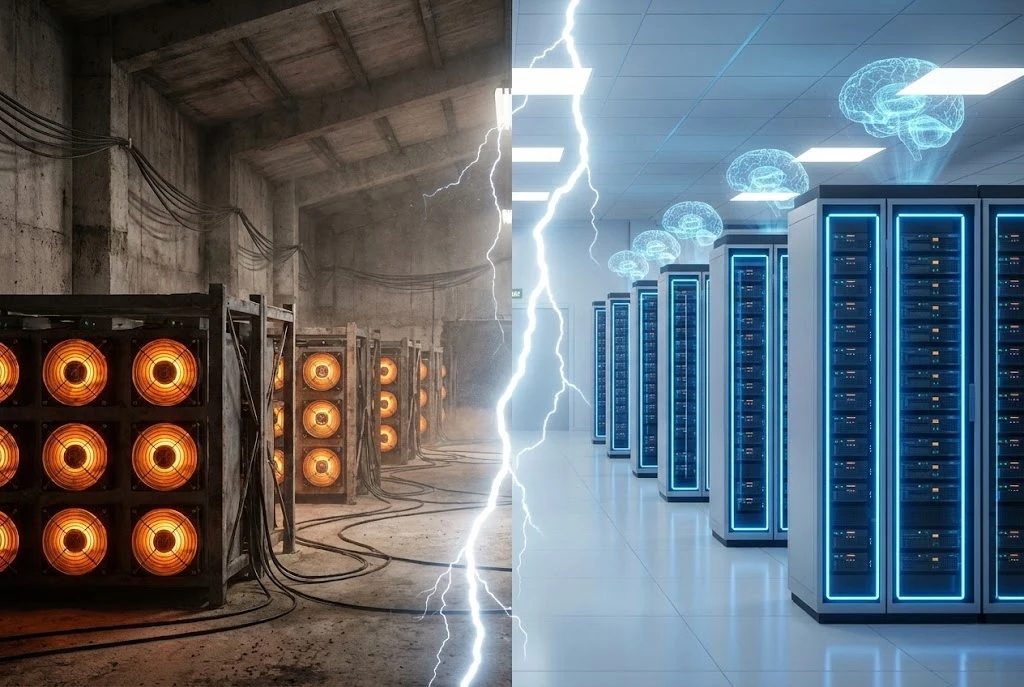
The golden age of simply plugging in an ASIC miner and printing money is over. A new, more profitable giant has entered the room, and it is hungry for electricity: Artificial Intelligence.
In November 2025, Core Scientific—one of the largest Bitcoin mining companies in North America—signed a $3.5 billion, 12-year contract with CoreWeave, an NVIDIA-backed AI infrastructure company. The deal involved converting Bitcoin mining facilities into high-performance computing centers for AI workloads. Within weeks, Core Scientific’s stock surged 40%.
This wasn’t an isolated event. Across the industry, miners faced a calculation: mine Bitcoin for $0.08 per kilowatt-hour, or rent the same infrastructure to AI companies for $0.50+ per kilowatt-hour. The economics weren’t subtle.
By late 2025, a quiet revolution had begun. Bitcoin miners—once the kings of electricity consumption—were being systematically outbid by AI companies desperate for computational power. The question wasn’t whether this shift would happen, but how fast and how completely.
📅 Originally Published: December 5, 2025
🔄 Last Updated: February 16, 2026
📊 Next Review: May 2026 (Quarterly updates with latest mining data)
After analyzing financial reports from major mining companies (Core Scientific, Riot Platforms, Hut 8), on-chain Bitcoin hashrate data, and the explosive growth of DePIN (Decentralized Physical Infrastructure) networks, one conclusion emerged: the future of crypto infrastructure isn’t just about hashing. It’s about computing.
This isn’t the death of Bitcoin mining—it’s an evolution. And for investors, it creates opportunities in an entirely new sector.
Part 1: The Economics of the Energy War
To understand why miners are pivoting, follow the money.
Bitcoin Mining: The Race to the Bottom
Bitcoin mining has always been a brutally competitive commodity business. But 2024-2025 made the economics even harsher:
The 2024 Halving
In April 2024, Bitcoin’s block reward halved from 6.25 BTC to 3.125 BTC. For miners, this meant revenue instantly dropped 50% while operational costs (electricity, cooling, maintenance) remained constant. Only the most efficient operations survived.
Competition at All-Time Highs
Bitcoin’s network hashrate reached 850 EH/s by late 2025—a record. More hashrate means more competition. Each miner’s share of block rewards shrinks as more computational power joins the network. The result: diminishing returns even as operational costs rise.
Revenue Volatility
Bitcoin mining revenue directly correlates to BTC price. When Bitcoin crashed from $126,000 to $60,000 in February 2026 (a 52% drop), miners who were barely profitable at $126,000 suddenly operated at massive losses. Many shut down operations entirely during the crash.
The Math
According to industry analysis:
- Average mining revenue: $100-150 per megawatt-hour (MWh)
- Average electricity cost: $40-80 per MWh (depending on location)
- Net margin: $20-110 per MWh
- Margin compression: Accelerating due to halving and hashrate growth
For context, a 100MW mining facility generates roughly $1-1.5 million monthly revenue at these rates. Operational costs consume 40-60% of revenue. After debt servicing, CAPEX for new equipment, and reserves, profit margins thin to 10-20% in good markets—and disappear entirely during Bitcoin bear markets.
AI Compute: The New Gold Rush
Training Large Language Models (LLMs) like GPT-4, Claude, or Gemini requires computational resources at a scale that makes Bitcoin mining look modest. And critically: AI companies will pay premium rates for that power.
Insatiable Demand
Every major tech company is building AI infrastructure:
- OpenAI trains GPT models requiring 10,000+ GPUs
- Google develops Gemini on massive clusters
- Meta builds LLaMA training infrastructure
- Microsoft, Amazon, Apple all investing billions
The bottleneck isn’t capital—it’s physical GPU availability and the power infrastructure to run them.
Supply Scarcity
NVIDIA H100 chips—the current gold standard for AI training—sell for $25,000-40,000 each and have 6-12 month waiting lists. Companies that can offer H100 clusters with reliable power command extraordinary premiums.
Stable, Long-Term Revenue
Unlike Bitcoin mining (where revenue depends on volatile BTC price), AI contracts lock in multi-year commitments. CoreWeave’s $3.5 billion deal with Core Scientific spans 12 years. These contracts provide revenue predictability that Bitcoin mining never could.
The Revenue Premium
According to Morgan Stanley and JPMorgan analysis:
- AI compute revenue: $500-1,000+ per megawatt-hour
- Bitcoin mining revenue: $100-150 per megawatt-hour
- Multiplier: 5-10x higher revenue on same energy
For a 100MW facility:
- Bitcoin mining: $1-1.5M monthly revenue
- AI compute: $5-10M monthly revenue
The economics are overwhelming. A mining company with $100 million in annual Bitcoin revenue could generate $500 million-1 billion annually running the same facility for AI workloads.
The “Megawatt” Math: Why Energy Matters More Than Hardware
Bitcoin mining and AI training share one critical requirement: massive amounts of reliable electrical power. The difference lies in what they do with that power.
Bitcoin Mining Energy Profile
- ASICs run continuously, 24/7
- Relatively simple cooling requirements
- Low internet bandwidth needs (submit hashes)
- Can tolerate intermittent power (throttle during outages)
AI Training Energy Profile
- GPUs run continuously during training cycles
- Sophisticated cooling requirements (GPUs generate more heat)
- High bandwidth internet (move massive datasets)
- Cannot tolerate power interruptions (corrupts training runs)
Despite these differences, existing mining facilities have most infrastructure in place:
- Electrical grid connections (often 100+ MW capacity)
- Industrial cooling systems (adaptable to GPU loads)
- Security and monitoring
- Remote locations (cheap power, low regulation)
This infrastructure reuse creates arbitrage opportunity: convert existing capital equipment from low-value use (Bitcoin) to high-value use (AI) without rebuilding from scratch.
Part 2: The Great Miner Pivot (Case Studies)
Theory is one thing. Execution is another. Here’s who’s actually making the transition—and how.
1. Core Scientific: The Industry Leader
The Deal
In November 2025, Core Scientific announced a 12-year, $3.5 billion contract with CoreWeave (backed by NVIDIA and Magnetar Capital). The deal involved converting 200+ MW of Bitcoin mining infrastructure into AI training facilities.
The Execution
Core Scientific didn’t abandon Bitcoin entirely. Instead, they:
- Converted 70% of capacity to AI/HPC hosting
- Maintained 30% Bitcoin mining (for Bitcoin exposure during bull markets)
- Repurposed existing buildings, cooling, and power infrastructure
- Signed take-or-pay contracts (CoreWeave pays regardless of usage)
The Results
- Stock price: Up 40% in two weeks following announcement
- Revenue visibility: Extended 12 years (vs. quarterly volatility in Bitcoin)
- Market cap: Increased from $400M to $2.5B within three months
- Debt refinancing: Improved terms due to stable cash flow projections
Why It Worked
Core Scientific had three advantages:
- Existing relationships with power utilities (already approved for 100+ MW loads)
- Physical infrastructure (buildings, cooling, security already built)
- Technical expertise (managing large-scale computational infrastructure)
The pivot wasn’t building new data centers—it was re-purposing existing assets for higher-value workloads.
2. Hut 8 & Hive Digital: The Hybrid Model
Rather than fully exiting Bitcoin, some miners adopted a hybrid approach.
Hut 8’s Strategy
- 60% capacity dedicated to Bitcoin mining
- 40% capacity available for HPC/AI rental
- Dynamic allocation: shift between Bitcoin and AI based on economic conditions
The Logic
Hut 8’s CEO explained: “We don’t want to abandon our Bitcoin mining thesis. But we also recognize that AI compute provides stable revenue during Bitcoin bear markets. The hybrid model gives us both.”
During Q4 2025:
- Bitcoin mining generated $8M revenue (low due to halving and price)
- AI/HPC hosting generated $15M revenue (70% higher on same energy)
- Total revenue: $23M (vs. $12M if 100% Bitcoin mining)
Hive Digital’s Approach
Hive went further, acquiring GPU inventory directly:
- Purchased 1,000 NVIDIA H100 GPUs ($30M investment)
- Converted one facility entirely to AI training
- Maintained two facilities for Bitcoin mining
Results:
- AI facility revenue: $4M monthly
- Bitcoin facilities revenue: $3M monthly combined
- Payback period on GPU investment: 18-24 months (vs. 36+ months for ASIC miners)
3. Riot Platforms & Marathon Digital: The Bitcoin Maximalists
Not everyone pivoted. Some miners doubled down on Bitcoin.
Riot’s Position
CEO Jason Les stated publicly: “We believe Bitcoin mining is the long-term play. AI is a distraction from our core mission: accumulating Bitcoin.”
Riot’s strategy:
- Zero AI diversification
- Continued ASIC purchases despite halving
- Focus on low-cost power (Texas wind/solar)
- HODL strategy (don’t sell mined Bitcoin)
The Results (Mixed)
- Q4 2025 revenue: Down 40% vs. Q4 2024
- Stock performance: Underperformed Core Scientific by 60%
- Bitcoin holdings: Increased to 15,000+ BTC
- Long-term thesis: Depends entirely on Bitcoin price appreciation
Marathon Digital’s Bet
Marathon took a middle path:
- 90% Bitcoin mining
- 10% experimenting with HPC
- Heavy investment in energy infrastructure (power purchase agreements)
The bet: Bitcoin’s long-term value will exceed short-term AI revenue. If Bitcoin reaches $500,000 by 2030 (some analysts’ bull case), miners who HODL Bitcoin mined at $60,000 will dramatically outperform those who pivoted to AI.
What This Means for Bitcoin’s Network
Will Bitcoin hashrate collapse if miners pivot to AI?
No, but it will redistribute geographically.
The Migration Pattern
- Premium grid power (US, Europe): Shifts to AI
- Stranded energy (flared gas, remote hydro): Remains with Bitcoin
- Emerging markets (Africa, South America): New Bitcoin mining hubs
Why Bitcoin Survives
Bitcoin mining will migrate to energy sources that AI companies don’t want:
- Flared natural gas in remote oil fields (Texas, North Dakota)
- Off-grid renewable energy (hydroelectric in Ethiopia, geothermal in El Salvador)
- Variable power sources (wind/solar with battery backup)
These locations provide cheap electricity but lack the infrastructure (fiber internet, cooling, reliability) that AI training requires. Bitcoin mining tolerates these constraints; AI training doesn’t.
The Result
Bitcoin’s network becomes more decentralized geographically, more dependent on renewable/stranded energy, and less concentrated in premium data center locations. This arguably strengthens Bitcoin’s censorship resistance—mining happens where regulation is minimal.
Part 3: The DePIN Opportunity (How to Invest)
You can’t easily buy shares in a private data center. But you can buy crypto tokens building decentralized compute infrastructure—the “DePIN” (Decentralized Physical Infrastructure Networks) sector.
1. Render Network ($RENDER)
Concept: Render connects users needing GPU compute (3D artists, video producers, AI developers) with people who have idle GPUs.
How It Works:
- Artists upload rendering jobs
- GPU providers (anyone with a gaming PC or mining rig) process jobs
- Payment in $RENDER tokens
- Quality verification via proof-of-render
The AI Expansion
Initially focused on 3D rendering, Render is expanding into AI workloads:
- AI image generation (Stable Diffusion, Midjourney-style)
- AI video generation (Runway, Pika alternatives)
- LLM fine-tuning (smaller models)
Market Position
- Market cap: $3-4B (Feb 2026)
- Monthly jobs processed: 50,000+
- Network size: 100,000+ GPUs globally
- Revenue model: Take 0.5-5% fee on transactions
Investment Thesis
Render is the most established DePIN project with:
- Real product (not vaporware)
- Growing revenue (fees paid in $RENDER)
- Network effects (more GPUs → cheaper compute → more users)
Risk:
Centralized cloud providers (AWS, Google Cloud) could undercut pricing with economies of scale. Render’s advantage is cost (no data center overhead) and censorship resistance (no ToS restrictions).
2. Akash Network ($AKT)
Concept: Akash is a decentralized cloud marketplace—think “Airbnb for compute.”
How It Works:
- Data centers list available capacity (CPU, RAM, storage, GPUs)
- Developers deploy applications via CLI (similar to AWS/GCP)
- Payment in $AKT or stablecoins
- Open-source, permissionless
The AI Angle
Akash added GPU support in 2024:
- Developers can rent NVIDIA GPUs for AI training
- Cost: 30-50% cheaper than AWS/GCP
- No KYC requirements
- Instant deployment
Market Position
- Market cap: $800M-1.2B
- Active deployments: 10,000+
- GPU inventory: Growing (miners converting to Akash providers)
- Enterprise customers: Several undisclosed (under NDA)
Investment Thesis
Akash has the most functional product in decentralized cloud:
- Working product for 3+ years
- Revenue generating (fees paid to $AKT stakers)
- Clear use case (cost-sensitive developers, privacy-conscious projects)
Risk:
Regulatory uncertainty (hosting potentially illegal content) and competition from centralized alternatives with better UI/UX.
3. Bittensor ($TAO)
Concept: Bittensor creates a decentralized marketplace for machine intelligence itself—not just compute, but AI model outputs.
How It Works:
- AI models compete to solve tasks
- Best-performing models earn $TAO rewards
- Validators assess quality and pay rewards
- Creates evolutionary pressure for better AI
Why It’s Different
Instead of renting GPUs, Bittensor rents intelligence:
- Want sentiment analysis? Query the network
- Need image classification? The best model responds
- Require text generation? Multiple models compete
Market Position
- Market cap: $5-7B (Feb 2026)
- Active subnets: 30+ (specialized AI tasks)
- Mining revenue: $2-5M daily (paid to subnet operators)
Investment Thesis
Bittensor is the “Bitcoin of AI”—first-mover advantage in decentralized ML:
- Novel architecture (no direct competition)
- Growing developer ecosystem
- Potential to become base layer for AI economy
Risk:
Extremely complex to understand. High token emission (inflation risk). Uncertain whether decentralized AI training can compete with centralized (OpenAI, Google) approaches.
4. Io.net (The Emerging Giant)
Concept: Io.net aggregates GPUs from multiple sources (data centers, crypto miners, Render Network) into unified clusters for machine learning engineers.
The Aggregation Play
Rather than building from scratch, Io.net connects:
- Existing GPU providers (miners pivoting to AI)
- DePIN networks (Render, Akash)
- Underutilized data center capacity
Market Position
- Not yet publicly traded (private funding rounds)
- GPU inventory: 200,000+ GPUs globally (claimed)
- Customers: ML engineers, AI startups, research institutions
Investment Opportunity
Watch for:
- Token launch (rumored for 2026)
- Airdrops to early users
- Partnership announcements
Why It Matters
If Io.net successfully aggregates fragmented GPU supply, they become the default marketplace for decentralized AI compute—similar to how Uber aggregated fragmented driver supply.
Part 4: Investment Strategies and Risk Assessment
Direct Mining Stock Plays
High-Risk, High-Reward: Pivoting Miners
- Core Scientific (CORZ): Leveraged play on AI hosting growth
- Hut 8 (HUT): Hybrid Bitcoin/AI exposure
- Hive Digital (HIVE): Early GPU acquisition strategy
Pros: Direct exposure to AI revenue shift, stable contracts, institutional backing
Cons: Execution risk (can they actually pivot successfully?), debt loads, Bitcoin exposure drag
Conservative: Bitcoin-Focused Miners
- Riot Platforms (RIOT): Pure Bitcoin accumulation play
- Marathon Digital (MARA): Bitcoin HODL strategy with scale
Pros: Benefit if Bitcoin reaches $200,000+, no pivot execution risk
Cons: Revenue volatility, margin compression, dependent on Bitcoin price
DePIN Token Exposure
Portfolio Allocation Framework
Aggressive (30-40% of crypto portfolio):
- 50% $TAO (highest risk/reward, first-mover in decentralized AI)
- 30% $RENDER (established product, growing market)
- 20% $AKT (undervalued relative to functionality)
Moderate (15-20% of crypto portfolio):
- 40% $RENDER (blue-chip DePIN)
- 40% $TAO (growth play)
- 20% $AKT (value play)
Conservative (5-10% of crypto portfolio):
- 60% $RENDER (most established)
- 40% $AKT (real revenue)
- 0% $TAO (too speculative)
Risk Management
What Could Go Wrong?
1. Hardware Incompatibility
Bitcoin ASICs cannot be converted to AI workloads. Miners must:
- Sell ASICs (likely at loss)
- Purchase NVIDIA GPUs ($25,000-40,000 each)
- Wait 6-12 months for GPU delivery
This creates massive capital requirements. Not all miners have balance sheets to support pivot.
2. Infrastructure Upgrade Costs
Converting mining facilities to AI data centers requires:
- Enhanced cooling systems: $500,000-2M per facility
- Upgraded internet connectivity: $100,000-500,000
- Data center certifications (Tier 3/4): $1-5M
- Total retrofit cost: $5-20M depending on scale
Miners with debt may not afford these upgrades.
3. Competition from Hyperscalers
AWS, Google Cloud, and Microsoft Azure have advantages:
- Economies of scale
- Better UI/UX
- Enterprise support
- Established trust
DePIN networks must compete on:
- Cost (30-50% cheaper)
- Censorship resistance
- Privacy (no data logging)
If hyperscalers drop prices, DePIN advantage shrinks.
4. Regulatory Pressure
AI is consuming increasing energy. The “environmental FUD” that attacked Bitcoin (e.g., “Bitcoin uses more energy than Argentina”) is now shifting to AI.
Headlines in late 2025:
- “AI Data Centers Use as Much Water as 100,000 Homes”
- “Training GPT-5 Emitted More Carbon than 1,000 Flights”
If governments regulate AI energy consumption, the entire thesis—that AI pays premium for energy—could be threatened.
5. Bitcoin Price Surge
If Bitcoin reaches $200,000-500,000, mining becomes extraordinarily profitable again. Miners who pivoted to AI might regret abandoning Bitcoin.
The opportunity cost of NOT mining Bitcoin (if it 5-10x) could outweigh AI revenue stability.
Frequently Asked Questions
Why are miners switching to AI instead of staying with Bitcoin?
Economics. AI companies pay 5-10x more per megawatt-hour than Bitcoin mining generates. After the 2024 halving cut Bitcoin mining revenue 50%, and with hashrate at all-time highs increasing competition, many miners faced a choice: earn $1-1.5M monthly mining Bitcoin, or earn $5-10M monthly hosting AI workloads. The math is overwhelming.
Is Bitcoin mining actually dead?
No. Bitcoin mining is migrating, not dying. Premium grid power in the US and Europe is shifting to AI because AI pays more. Bitcoin mining will move to:
- Stranded energy sources (flared gas in oil fields)
- Off-grid renewable energy (remote hydroelectric, geothermal)
- Emerging markets (Africa, South America, Southeast Asia)
These locations have cheap power but lack infrastructure AI requires. Bitcoin mining thrives in exactly these conditions.
Which mining companies are successfully pivoting?
Clear winners:
- Core Scientific: $3.5B AI contract with CoreWeave
- Hut 8: Hybrid model (60% Bitcoin, 40% AI)
- Hive Digital: Direct GPU purchases, full facility conversion
Still Bitcoin-focused:
- Riot Platforms: 100% Bitcoin, betting on price appreciation
- Marathon Digital: 90% Bitcoin, minimal AI experimentation
Success depends on execution. Converting facilities requires massive capital, technical expertise, and time.
Are DePIN tokens a good investment?
DePIN represents legitimate infrastructure demand—AI needs compute, and decentralized networks can provide it cheaper than centralized clouds. However:
Pros:
- Real product-market fit (developers using these networks)
- Growing revenue (fees paid in tokens)
- First-mover advantage in decentralized AI
Cons:
- High token inflation (dilutes holders)
- Competition from AWS/Google/Azure
- Regulatory uncertainty
- Technical complexity (hard to evaluate)
Treat DePIN tokens as high-risk venture bets. Allocate 5-15% of crypto portfolio maximum.
How do mining stocks compare to DePIN tokens?
Mining stocks:
- Regulated, audited financials
- Trade on traditional exchanges (NASDAQ)
- More price stability (less volatility than crypto)
- Dividend potential (some companies pay dividends)
DePIN tokens:
- Unregulated, high volatility
- Trade on crypto exchanges 24/7
- Speculative (valuation based on future adoption)
- Governance rights (participate in protocol decisions)
Conservative investors: mining stocks
Aggressive investors: DePIN tokens
Balanced approach: Both
What’s the environmental impact comparison?
Bitcoin mining:
- ~150 TWh annually (roughly Norway’s energy consumption)
- Increasingly renewable-powered (58% renewable by 2025)
- Uses stranded/waste energy (flared gas, curtailed renewables)
AI training:
- ~200 TWh annually and growing rapidly (estimate for all global AI)
- Mostly grid-powered (30-40% renewable)
- Cannot use intermittent power (training runs can’t pause)
Both consume substantial energy. The debate isn’t which uses more, but whether the value created justifies consumption. AI companies argue their models drive productivity gains worth the cost. Bitcoin advocates argue decentralized money is worth securing.
How long will the AI compute boom last?
Bull case: 10+ years
AI is in early innings. Current models require massive compute. Future models will require even more. As AI applications expand (autonomous vehicles, robotics, personalized medicine), compute demand grows exponentially.
Bear case: 3-5 years
AI may hit diminishing returns. If models plateau in capability, demand for training compute declines. Hardware advances (more efficient chips) reduce power needs. Hyperscalers build sufficient capacity, eliminating scarcity premium.
Most likely: 5-8 years of strong growth, then maturation
Similar to cloud computing—explosive growth 2010-2020, then stabilization. DePIN networks have a window to capture market share before hyperscalers fully scale.
Should I invest in Bitcoin miners pivoting to AI?
Depends on risk tolerance:
Yes, if:
- You believe AI compute demand is sustained (5+ years)
- You want exposure to AI infrastructure without buying tech stocks
- You can tolerate 30-50% stock volatility
- You trust management teams to execute pivots
No, if:
- You’re purely bullish on Bitcoin (buy Bitcoin or Bitcoin-only miners instead)
- You can’t handle volatility (these stocks swing wildly)
- You don’t understand the business model
- You need income (most don’t pay dividends during pivot)
Allocation suggestion: If interested, limit to 5-10% of portfolio, diversify across 3-4 companies.
The Bottom Line: Symbiosis, Not Replacement
Bitcoin mining isn’t dying—it’s evolving. We’re entering an era of energy arbitrage where:
Tier 1 Power (Stable Grid, High Bandwidth):
Goes to AI. Hyperscalers and converted miners will dominate this market. The economics are too compelling—$5-10M monthly revenue vs. $1-1.5M for the same energy spend.
Tier 2 Power (Intermittent, Remote, Stranded):
Goes to Bitcoin. Miners will migrate to locations where energy is cheap or free but lacks infrastructure AI needs. This includes:
- Flared natural gas in remote oil fields (would otherwise be wasted)
- Off-grid hydroelectric in developing nations
- Curtailed renewable energy (excess solar/wind with no storage)
The Investment Thesis
For crypto investors, the play is clear:
1. Hold Bitcoin ($BTC): Ultimate store of value. If miners pivot to AI but Bitcoin price 10x’s, Bitcoin holders win regardless of hashrate distribution.
2. Selective Miner Exposure: Core Scientific, Hut 8, or Hive Digital for AI pivot exposure. Riot or Marathon for pure Bitcoin accumulation bet.
3. DePIN Infrastructure ($RENDER, $AKT, $TAO): Capture growth of decentralized compute. These networks benefit from miner pivots (more GPU supply) and AI demand (more customers).
The Risk Balance
Don’t over-allocate. This sector faces:
- Execution risk (pivots may fail)
- Competition risk (hyperscalers may dominate)
- Regulatory risk (energy consumption scrutiny)
- Bitcoin price risk (if BTC moons, miners who pivoted away miss upside)
Suggested Allocation:
- 60-70%: Bitcoin (core position)
- 15-20%: DePIN tokens (growth play)
- 10-15%: Mining stocks (leveraged infrastructure bet)
- 5-10%: Cash reserves (deploy during crashes)
The energy war has just begun. For the first time, crypto has a powerful ally—not an enemy—in Big Tech. Both Bitcoin and AI require massive computational infrastructure. The miners building that infrastructure stand to benefit from both.
The question isn’t Bitcoin vs. AI. It’s how crypto infrastructure captures value in an AI-dominated world.
About This Analysis
Research Methodology: This analysis synthesizes publicly available data including mining company earnings reports (10-K, 10-Q filings), on-chain Bitcoin hashrate data, DePIN protocol metrics, energy market reports, and industry analysis from financial institutions.
Data Sources:
- Mining company financial filings (SEC EDGAR database)
- Bitcoin network data (Blockchain.com, CoinMetrics)
- DePIN protocol metrics (TokenTerminal, DeFiLlama)
- Energy market analysis (Morgan Stanley, JPMorgan, BloombergNEF)
- Industry reports (Bitcoin Mining Council, Galaxy Digital)
Last Updated: February 16, 2026
Authors: CryptoScopeLab Research Team
Contact: contact@cryptoscopelab.com
Risk Disclaimer
Cryptocurrency and stock investments carry substantial risk of loss. Mining companies face operational risks including hardware failure, energy price volatility, regulatory changes, and competition. DePIN tokens are highly speculative and may experience extreme price volatility. This analysis provides educational information only and does not constitute financial, investment, or legal advice.
Key Risks:
- Business Risk: Mining company pivots may fail, contracts may not materialize
- Market Risk: Cryptocurrency and stock prices exhibit extreme volatility
- Technology Risk: Hardware becomes obsolete, network attacks, protocol failures
- Regulatory Risk: Energy regulations, securities laws, tax treatment changes
- Competition Risk: Hyperscalers (AWS, Google) may dominate AI compute market
Always:
- Invest only capital you can afford to lose completely
- Conduct independent research beyond this analysis
- Consult qualified financial advisors before making investment decisions
- Diversify across multiple assets and sectors
- Monitor positions regularly and rebalance as conditions change
Past performance does not guarantee future results. The authors and CryptoScopeLab hold positions in cryptocurrencies and tokens discussed and may have conflicts of interest.
Related Guides
Looking to understand the broader crypto infrastructure landscape? Check out these essential analyses:
- Best Crypto Exchanges 2026 – Where to buy mining stocks and DePIN tokens
- Bitcoin Bottom Formation 2026 – Understanding Bitcoin price dynamics affecting mining
- The RWA Revolution – Tokenization trends similar to DePIN infrastructure
- The ‘MicroStrategy of Ethereum’ – Institutional crypto accumulation strategies
- Top 5 ‘Sleeping Giant’ Altcoins – Including DePIN infrastructure plays
- Bitcoin & Gold Liquidity Crisis – Macro factors affecting mining profitability
- Bull Trap or Reversal? – Market timing for mining stock entries
Questions about Bitcoin mining or AI infrastructure investing?
📧 Email: contact@cryptoscopelab.com
🐦 Twitter: @CryptoScopeLab
Found this analysis helpful? Share it with fellow investors navigating the mining-to-AI transition.