Two days ago, the crypto industry crossed a threshold that seemed impossible just twelve months earlier.
Kraken Financial — the Wyoming-chartered banking arm of the cryptocurrency exchange — became the first digital asset firm in U.S. history to receive a Federal Reserve master account. That sentence might not sound explosive to casual investors, but to anyone who’s been watching the regulatory chess match between crypto and traditional finance, this is the equivalent of watching the Berlin Wall come down.
For context: crypto firms have been trying to get this exact approval for over half a decade. Some have sued. Others have lobbied Congress. A few spent millions on legal fees just to get a foot in the door. Every single one was rejected — until now.
So what exactly happened, why does it matter, and what comes next?
What Is a Fed Master Account, Anyway?
Before we talk about why this is a big deal, let’s quickly explain what Kraken actually got.
A Federal Reserve master account is essentially a VIP pass to the U.S. banking system’s core infrastructure. It allows the holder to move money directly through the Federal Reserve’s payment rails — specifically a network called Fedwire — without needing to route transactions through a partner bank.
Think of it this way: Until now, if you wanted to deposit $100,000 into Kraken, the exchange couldn’t just receive that money directly from the Fed. Instead, it had to rely on an intermediary — usually a small regional bank willing to work with crypto firms. That bank would hold the dollars, process the transfers, and charge fees for the privilege. It created delays, added costs, and introduced a chokepoint that regulators or hostile banks could shut down at any time.
With a master account, Kraken can bypass all of that. Deposits and withdrawals happen directly on the same payment infrastructure used by JPMorgan, Bank of America, and every other major financial institution in the country. There’s no middleman. No bank that can suddenly decide it doesn’t want to work with crypto anymore.
The account does come with limits. Kraken won’t earn interest on reserves parked at the Fed. It won’t have access to the discount window — the emergency lending facility available to traditional banks. And the approval is classified as “limited purpose,” meaning it’s restricted to specific payment functions rather than the full suite of services a standard master account provides.
But even with those restrictions, this is the regulatory equivalent of being invited to sit at the adults’ table.
Why This Approval Is Shocking (And Why It Took So Long)
To understand why Kraken’s approval is such a watershed moment, you need to know the history.
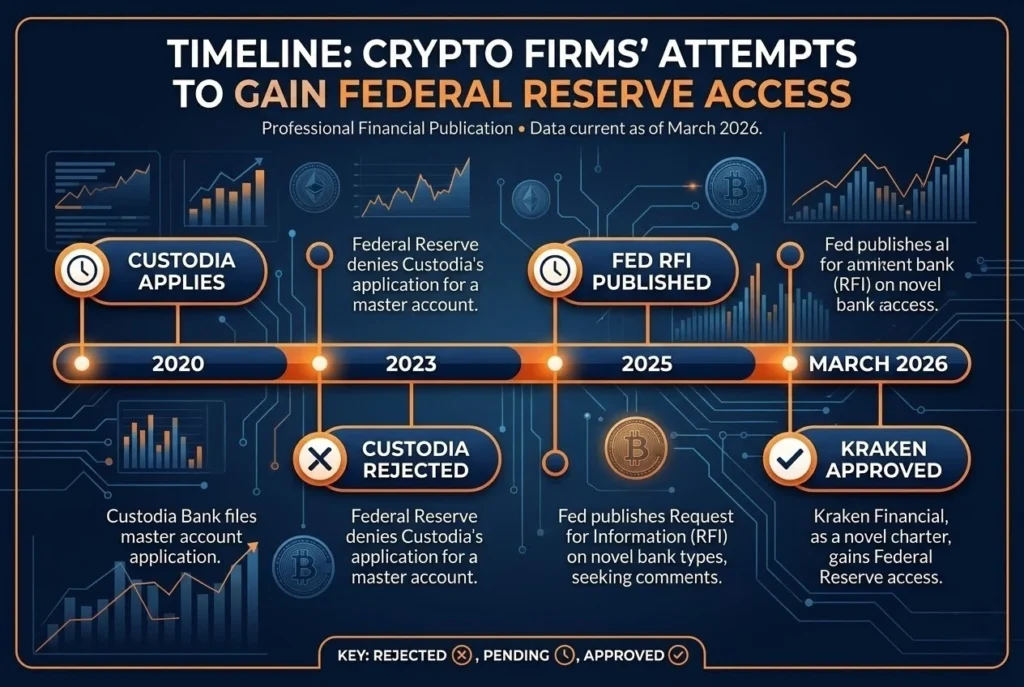
In 2020, a Wyoming-based firm called Custodia Bank — founded by former Wall Street executive Caitlin Long — applied for a Fed master account. Custodia wasn’t trying to do anything radical. It was a fully chartered, 100% reserve bank designed to bridge digital assets and traditional finance.
The Fed didn’t just reject the application. It delayed for months, then years, before finally denying Custodia in January 2023. The decision sparked a lawsuit that’s still pending. Long publicly argued that the Fed was stonewalling crypto firms for political reasons, not legitimate risk concerns.
Other firms faced similar roadblocks. Anchorage Digital, a federally chartered trust bank with a client roster that includes institutional investors and venture funds, has been trying to secure full master account access for years. No dice.
Even during the Trump administration’s early pro-crypto signals in 2025, the regulatory environment remained hostile. Then, suddenly, Kraken broke through.
So what changed?
Multiple factors aligned at once. Wyoming’s Special Purpose Depository Institution (SPDI) charter played a role — it’s a state-level banking license designed specifically for digital asset custody, and it requires firms to hold 100% liquid reserves. That full-reserve model addresses one of the Fed’s biggest concerns: the risk of bank runs or fractional reserve failures.
Kraken also spent five years building a compliance infrastructure that satisfied both Wyoming state regulators and the Kansas City Fed. That included anti-money laundering systems, operational safeguards, and close coordination with supervisors.
But timing mattered too. The Federal Reserve has been under pressure to modernize its master account policies. In December 2025, the Fed published a Request for Information on so-called “skinny accounts” — a streamlined version of master accounts designed for firms that only need payment services, not the full banking toolkit. Kraken’s approval arrived before the Fed finalized that policy, which means the Kansas City Fed essentially jumped ahead of the national framework.
Some analysts see this as the Fed testing the waters. Others see it as the regional Fed banks asserting independence before the Board of Governors locks down the rules.
Either way, the door is now open.
The Banking Lobby Is Not Happy
If you want to understand how significant this moment is, just look at who’s angry about it.
The Bank Policy Institute — a lobbying group that represents the largest commercial banks in the U.S. — issued a statement calling the decision “deeply concerning.” They argued that the Kansas City Fed approved the account before the national policy framework was finalized, essentially short-circuiting the public comment process and creating a precedent without proper oversight.
Paige Pidano Paridon, co-head of regulatory affairs at the Institute, didn’t hold back: “This action ignores public comment that the Federal Reserve sought on this framework, and it was issued with no transparency into the process for approval or the risk mitigants that have been imposed.”
Translation: The banking establishment is worried that crypto firms are getting access to the Fed’s payment system without going through the same regulatory gauntlet that traditional banks endure.
And they’re not wrong to be concerned — at least from a competitive standpoint. If crypto firms can settle payments directly through the Fed while operating under a lighter regulatory regime than commercial banks, that creates an uneven playing field. Banks have to comply with deposit insurance requirements, capital ratios, stress tests, and a mountain of other rules. Crypto firms with skinny master accounts? Not so much.
The Independent Community Bankers of America went even further, arguing that “expanding direct Fed account access to institutions that operate outside the traditional banking regulatory framework” introduces “significant risks” to the financial system.
But here’s the thing: that ship has already sailed. The Fed approved the account. The precedent is set. And the genie isn’t going back in the bottle.
What This Means for Bitcoin, Crypto Prices, and the Market
Let’s get to the question everyone wants answered: Does this make Bitcoin go up?
The honest answer is: not directly, not immediately. Kraken’s master account approval doesn’t change Bitcoin’s supply dynamics, its mining economics, or its role as a non-sovereign asset. It’s a regulatory milestone, not a price catalyst.
But indirectly? This could matter a lot.
Here’s why: Institutional investors have been sitting on the sidelines for years, waiting for regulatory clarity. They want exposure to digital assets, but they need infrastructure they can trust. That means banks they can custody with, payment rails they can settle on, and legal frameworks they can navigate.
Kraken’s approval sends a signal that crypto is moving from the regulatory fringe into the regulated core of the U.S. financial system. It tells institutional allocators that the path forward isn’t just speculation — it’s integration.
And when institutions gain confidence, capital follows.
We’re already seeing this play out in the spot Bitcoin ETF market. Despite four consecutive months of net outflows earlier this year, February’s outflows dropped 94% compared to November. Analysts at TD Cowen described Kraken’s approval as “the first of many Federal Reserve approvals for crypto entities,” predicting a wave of similar announcements in the coming months.
If Circle (the issuer of USDC), Anchorage Digital, and other well-capitalized firms secure master accounts, the industry’s reliance on fragile banking partnerships evaporates. That reduces systemic risk, which in turn makes institutional adoption easier.
But there’s a flip side. The more crypto plugs into the Fed’s payment system, the more it becomes subject to the Fed’s rules, oversight, and potential intervention. If a crisis hits — say, a sudden rush to convert crypto into dollars during a market crash — a Fed-connected crypto bank could transmit that stress directly into the broader financial system. Regulators could respond by imposing emergency restrictions, freezing accounts, or pulling master account privileges.
This isn’t theoretical. The Fed has tools to manage liquidity shocks, but those tools come with strings attached. Crypto’s ethos has always been about decentralization and sovereignty. The more integrated it becomes with central bank infrastructure, the less sovereign it actually is.
That tension isn’t going away.
Who’s Next? The Race for Fed Access Is On
Analysts are already placing bets on which crypto firms will secure master accounts next.
Circle is an obvious candidate. The company issues USDC, the second-largest stablecoin by market cap, and has been lobbying for clearer regulatory treatment for years. A Fed master account would allow Circle to settle USDC redemptions directly through Fedwire, eliminating counterparty risk and boosting institutional confidence.
Anchorage Digital is another strong contender. As a federally chartered trust bank, it’s already operating under OCC supervision, which gives it credibility with regulators. The firm has been seeking full master account access — not just a skinny version — which would include earning interest on reserves and accessing the discount window.
Custodia Bank remains in legal limbo. Despite losing its initial master account lawsuit, the firm hasn’t given up. If the policy environment continues to shift in crypto’s favor, Custodia could refile or pursue alternative pathways.
Beyond those names, expect a flood of applications from stablecoin issuers, custody platforms, and payment processors. The infrastructure is being built. The precedent is set. The question now is how fast the Fed will move.
Senator Cynthia Lummis — a Republican from Wyoming and one of crypto’s most vocal advocates in Congress — called Kraken’s approval a “watershed moment” and predicted that banks will start acquiring digital asset firms (or vice versa) as the lines between traditional and crypto finance blur.
“In the future, you’re going to see banks buying digital asset companies,” Lummis told CNBC. “You’re also going to see digital asset companies buying banks.”
That future might arrive faster than most people expect.
The Bigger Picture: What This Says About Crypto in 2026
Kraken’s master account approval is one data point in a much larger pattern.
Spot Bitcoin ETFs launched in 2024 and now hold billions in assets. Major banks like Morgan Stanley have started offering Bitcoin exposure to wealth management clients. BlackRock launched a tokenized money market fund that crossed $500 million in assets. The U.S. established a Strategic Bitcoin Reserve via executive order in March 2025.
Each of these developments represented another step toward legitimacy. Kraken’s Fed access is the latest — and arguably the most structurally significant.
Because here’s the thing: ETFs are wrappers. They let investors gain exposure to Bitcoin without touching the underlying asset. Tokenized funds are experiments. Strategic reserves are symbolic.
But direct access to the Federal Reserve’s payment infrastructure? That’s not symbolic. That’s plumbing. That’s the foundation of the financial system.
When crypto firms can settle payments on the same rails as Goldman Sachs and Citibank, you’re no longer talking about an alternative financial system. You’re talking about integration.
And integration comes with trade-offs. Crypto gains legitimacy, infrastructure, and institutional capital. But it also gains oversight, regulation, and dependence on the very institutions it was originally designed to bypass.
Whether that’s a net positive or a Faustian bargain depends on what you think crypto is for. If the goal is maximum adoption and price appreciation, integration is probably good. If the goal is sovereignty and censorship resistance, it’s more complicated.
For now, the market seems to be interpreting this as a win. Bitcoin surged from around $64,000 to above $73,000 in the past week, liquidating over $587 million in bearish positions. Fear and Greed sentiment is recovering from extreme lows. Institutional flows are stabilizing.
Kraken’s master account approval didn’t cause that rally. But it’s part of the same story: crypto is no longer fighting to survive. It’s fighting to define what it becomes.
And right now, it’s becoming part of the system.
Key Takeaways:
- Kraken Financial is the first crypto firm to receive a Federal Reserve master account, granting direct access to the Fed’s payment infrastructure
- The approval allows Kraken to settle dollar transactions through Fedwire without relying on intermediary banks
- Traditional banking lobbies have condemned the decision, arguing it bypasses proper regulatory oversight
- Analysts predict a wave of similar approvals for firms like Circle, Anchorage Digital, and others
- The move represents crypto’s deepest integration into the U.S. financial system to date, with both opportunities and risks
Related Articles:
- Bitcoin Bottom Formation 2026: Why This Capitulation Could Be Different
- Top 5 Sleeping Giant Altcoins to Accumulate Before 2026
- The RWA Revolution: Top 3 Real-World Asset Tokens to Watch in 2026
Disclaimer: This article is for informational purposes only and does not constitute financial advice. Cryptocurrency investments carry significant risk. Always conduct your own research before making investment decisions.